
In the high-stakes world of sim centres, your most expensive asset isn't the hardware; it's the floor space it occupies. You likely already know the struggle of trying to fit enough rigs to turn a profit whilst ensuring every customer feels the visceral, teeth-rattling reality of a professional circuit. Balancing these competing demands is the ultimate key to a healthy commercial racing simulator ROI. For too long, achieving elite-level motion meant sacrificing your margins to massive industrial footprints and complex setups that bled revenue through constant maintenance downtime.
This guide reveals how to transform your business model by prioritising high-fidelity density. We'll explore how the LowSlider 6 DOF Twin-Traction-Loss Motion Platform delivers professional-grade driver training fidelity without the logistical nightmare of traditional, bulky rigs. You'll learn how to slash assembly times to under an hour and significantly reduce overheads, ensuring your centre stays operational and highly profitable. We're moving beyond basic arcade setups into a new era where precision engineering meets commercial viability, proving that you don't need a hangar-sized venue to deliver a world-class racing experience.
Key Takeaways
- Understand why authentic 6 DOF telemetry is replacing basic vibration rigs to meet rising customer expectations for professional-grade realism.
- Discover how compact, high-fidelity rig designs can dramatically enhance your commercial racing simulator ROI by increasing revenue per square metre.
- Explore the technical advantages of the LowSlider 6 DOF Twin-Traction-Loss Motion Platform in delivering elite feedback within a space-efficient footprint.
- Minimise implementation delays and labour costs by utilising a proprietary modular system designed for rapid, one-hour assembly.
- Identify the key logistics and maintenance strategies that ensure your sim centre remains profitable and operational with minimal overheads.
Defining the 2026 Commercial Motion Simulator Standard
The landscape of sim racing centres is undergoing a radical shift. By 2026, the threshold for a premium experience has moved beyond simple visual immersion into the territory of high-fidelity physical feedback. Basic "vibration" rigs that rely on simple rumble motors are no longer enough to satisfy a market increasingly populated by savvy enthusiasts and professional drivers. Today, a commercial motion simulator is a high-duty-cycle platform that translates software telemetry into precise physical G-forces for professional application. This evolution is driven by customers who expect the nuanced, multi-axis feedback found in a full motion racing simulator rather than a mere gaming peripheral.
To secure a strong commercial racing simulator ROI, your equipment must bridge the gap between entertainment and legitimate driver training. Whilst a home user might only spend a few hours a week in the cockpit, a commercial venue demands hardware that can withstand 12+ hours of continuous operation without performance fade or thermal throttling. If the motion becomes sluggish or the actuators overheat during a peak Saturday shift, your revenue stops instantly. Reliability in this high-intensity environment is the baseline for profitability.
Static vs. Motion: The Evolution of Commercial ROI
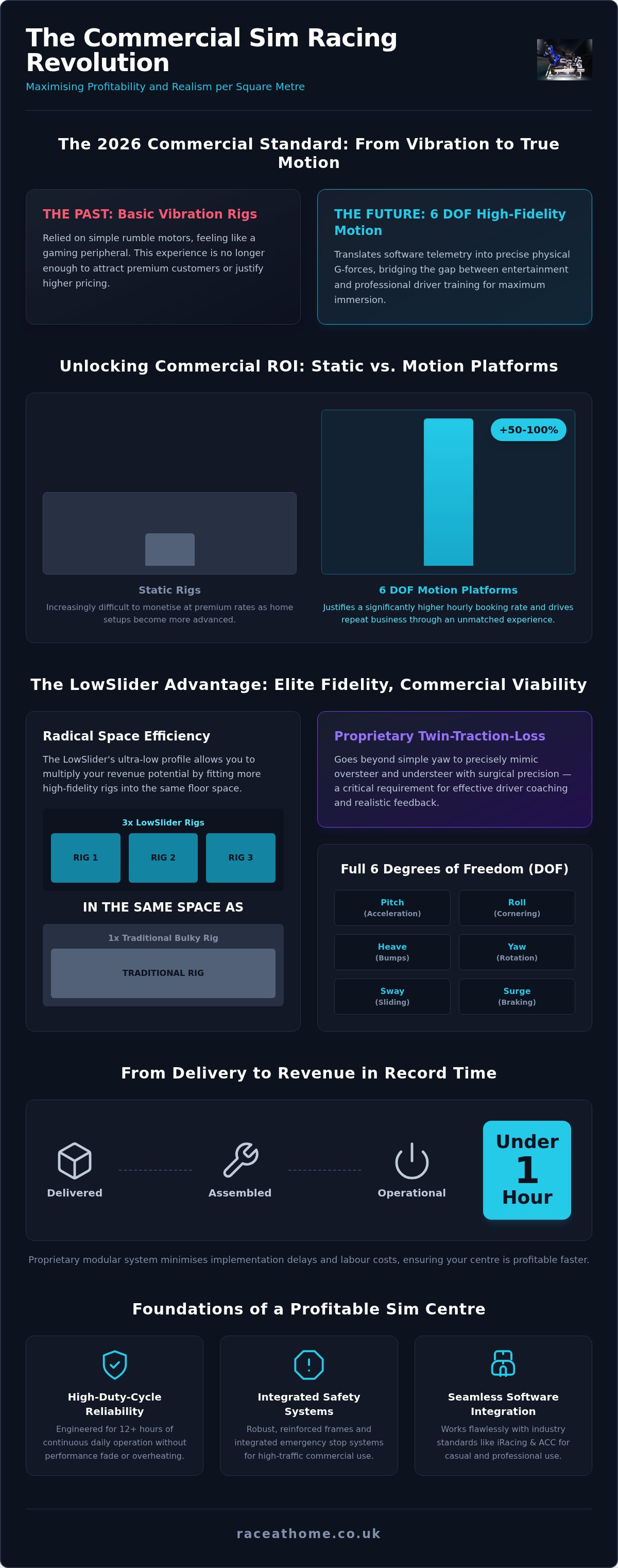
Static rigs are increasingly difficult to monetise at premium price points. As high-quality direct drive wheels and load-cell pedals become common in home setups, customers are less willing to pay for a static experience they can replicate in their spare room. Motion platforms change the financial equation entirely. By offering 6 Degrees of Freedom (DOF), you provide a visceral sensation of speed and weight transfer that is physically impossible to achieve without specialised hardware. This level of immersion justifies a 50-100% higher hourly booking rate compared to static alternatives. More importantly, it drives repeat visits; once a driver feels the rear tyres losing grip through their hips, a static seat feels lifeless by comparison.
Key Requirements for Business-Grade Hardware
Reliability is the foundation of any successful sim centre. You need industrial-grade components, such as PT Actuators, which are engineered for the high-frequency vibrations and rapid direction changes inherent in elite racing. These systems ensure that your commercial racing simulator ROI isn't eroded by constant maintenance or component failure. Safety is equally critical. Business-grade rigs must include integrated emergency stop systems and robust, reinforced frames capable of handling high-traffic use without developing structural flex. Finally, seamless software integration with industry-standard titles like iRacing and Assetto Corsa Competizione is essential for professional coaching services, allowing you to diversify your revenue streams beyond casual arrive-and-drive sessions.
Technical Excellence: 6 DOF and the LowSlider Advantage
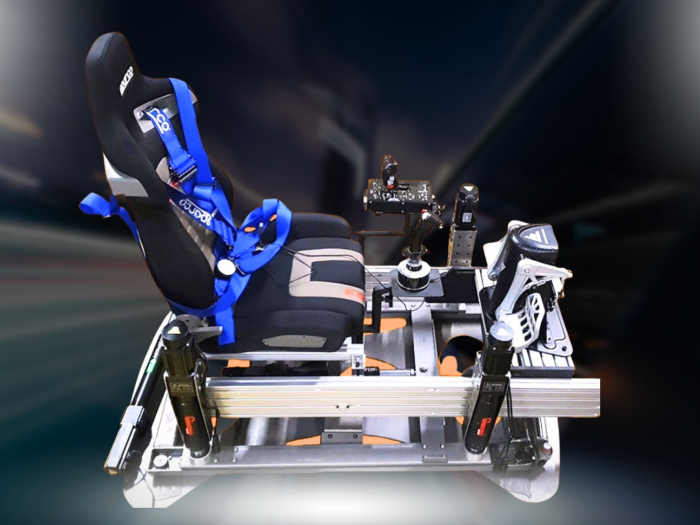
Achieving technical excellence in a commercial environment requires more than just powerful motors; it demands a sophisticated translation of digital telemetry into physical sensation. The LowSlider 6 DOF Twin-Traction-Loss Motion Platform represents the current commercial benchmark by providing full 6 Degrees of Freedom: Pitch, Roll, Heave, Yaw, Sway, and Surge. These six axes allow a driver to feel everything from the compression of suspension under heavy braking (Surge and Pitch) to the lateral G-forces of a high-speed apex (Sway and Roll). Unlike traditional, oversized industrial simulators that require significant floor space and complex mounting, the LowSlider utilises a proprietary ultra-low profile design. This compact footprint is a vital component of strategic manufacturing simulation principles, allowing venue owners to maximise their floor space without compromising on motion fidelity. When you can fit three high-fidelity rigs in the space usually reserved for one, your commercial racing simulator ROI shifts from precarious to predictable.
The Role of Twin Traction Loss in Professional Training
Feeling the rear end of a car breakaway is the single most important requirement for effective driver coaching. Whilst many systems use a single-axis yaw to simulate sliding, the LowSlider employs a proprietary twin-traction-loss system. This setup mimics oversteer and understeer with surgical precision, allowing drivers to catch a slide before it ends in the gravel. By positioning the rig as a dedicated motion simulator for driver training, centres can attract professional teams looking for seat time that actually translates to the track. It's this level of nuance that separates a professional simulator from a common arcade attraction.
Engineering for Immersion: Reducing Latency
Realism lives or dies by latency. If the physical movement lags behind the visual data by even a few milliseconds, the immersion breaks and motion sickness sets in. We utilise high-speed actuators that bridge this gap, delivering instantaneous feedback that matches the on-screen action. The LowSlider frame is hand-built in the UK to eliminate energy-wasting flex, ensuring that every Newton of torque from the direct drive wheel and every millimetre of actuator travel goes directly to the driver. This precision engineering ensures that your customers don't just see the race; they feel the grit of the kerbs and the snap of the tyres. You can explore our technical specifications to see how we outpace the competition through superior build quality.
The Business Case: Maximising ROI Through Space Efficiency
Commercial property rates are relentless. Every square metre of your venue must pull its weight. If you're using oversized industrial rigs, you're essentially paying rent for empty air rather than active racing. The LowSlider 6 DOF platform addresses this by delivering elite realism within a footprint that is significantly smaller than traditional motion systems. This space efficiency is a primary driver of a healthy commercial racing simulator ROI, as it allows for a higher density of revenue-generating units without increasing your fixed lease costs. High-fidelity motion also enables you to introduce "Pro Level" pricing tiers, allowing you to charge a premium for an experience that authentically mimics professional motorsport.
Maximising Floor Space in Sim Centres
By opting for a low-profile, compact design, venue owners can often fit 20% more rigs into the same floor area. This isn't just about packing machines into a room; it's about optimising the layout for safe customer flow and clear sightlines. For urban venues where space is at a premium, the LowSlider is the premier buy motion simulator UK choice. Our engineering principles align with modern research in Human-Computer Interaction (HCI), ensuring that the physical interface between driver and machine is as efficient as it is immersive. When you maximise your "Revenue per Square Metre," your path to profitability becomes much shorter.
Reliability and Maintenance in High-Traffic Environments
Maintenance is the silent killer of profitability. A rig that sits idle due to a component failure is a rig that is actively costing you money. Our hand-built UK rigs utilise modular components designed for rapid on-site servicing. If a part needs attention, your staff can often handle it quickly without waiting days for a specialist technician. Race@Home rigs are built to order in our UK workshop, ensuring they handle the 24/7 duty cycles required for business operations. When calculating your commercial racing simulator ROI, you must account for the total cost of ownership. A "cheap" rig with frequent downtime quickly becomes a financial liability, whilst a reliable, precision-engineered platform remains a consistent revenue asset.
Rapid Implementation: From Shipping to Revenue in One Hour
Speed of deployment is a critical, yet frequently ignored, component of your commercial racing simulator ROI. If your venue remains closed for a week whilst technicians struggle with complex assembly, you've already started in the red. Race@Home rigs are hand-built in the UK and shipped in a proprietary 4-piece modular format. This design drastically reduces the time and labour costs associated with initial business setup. By simplifying the physical logistics, we ensure that your capital starts working for you the moment it arrives on your doorstep.
Global Logistics and Rapid Deployment
Our 4-piece modular model is a major logistics advantage for international sim centres and racing teams. This structure reduces customs complexity and significantly lowers freight costs compared to shipping oversized, fully assembled industrial platforms. Worldwide shipping becomes a predictable part of your expansion strategy rather than a hurdle. We provide a clear one-hour assembly promise; you can move from opening the delivery crate to hosting your first paying customer in just 60 minutes. Standardising your venue with identical rigs further simplifies operations. Your staff only need to master one system, making maintenance and troubleshooting a streamlined, internal process.
Optimising the User Experience for High Throughput
Maximising session turnover is essential for maintaining high revenue during peak hours. Every minute spent faffing with seat sliders or pedal distances is a minute of lost profit. Our rigs include quick-adjust features that allow staff to accommodate different driver heights in seconds. For venues seeking the absolute peak of immersion, integrating a Pimax VR motion simulator setup provides a 200-degree field of view that perfectly complements our 6 DOF telemetry. This combination creates a "wow factor" that justifies premium pricing and encourages social media sharing.
Efficiency also extends to software management. By using pre-configured profiles, your team can instantly toggle between a stabilised "novice" mode for casual visitors and a raw, high-fidelity "pro" mode for serious competitors. This versatility ensures your centre appeals to the widest possible demographic without requiring complex recalibrations between bookings. If you are ready to accelerate your venue's launch, you can view our commercial shipping options to get started today.
Scaling Your Business with Race@Home Engineering
Scaling a sim racing venue requires a partner that understands the intersection of mechanical endurance and financial viability. The LowSlider 6 DOF Twin-Traction-Loss Motion Platform is the most efficient revenue generator for 2026 because it solves the space-versus-realism paradox. By delivering elite feedback in a compact frame, you maximise your throughput per square metre. This efficiency ensures that your commercial racing simulator ROI remains resilient even as market competition increases and property costs fluctuate. You aren't just buying equipment; you're installing a high-performance asset designed for continuous commercial duty.
Bespoke Engineering for Professional Teams
Working directly with our UK-based design team offers a level of customisation that off-the-shelf industrial simulators cannot match. We can configure rigs to replicate the specific ergonomics and telemetry profiles of different racing disciplines, such as GT3 or Formula. This bespoke approach allows you to market your centre to professional racing teams and serious academy drivers who require high-fidelity training tools. Our modular architecture means your investment is future-proof. If new actuator technology or G-seat hardware emerges, the LowSlider frame is designed to accommodate these upgrades without requiring a complete fleet replacement. You're investing in a platform that evolves alongside the industry.
The long-standing sim racing motion rig worth it debate is effectively settled when viewed through the lens of commercial operations. For a home enthusiast, the value might be subjective; for a business owner, the answer is found in the higher booking rates and superior customer retention that only 6 DOF motion can provide. High-fidelity density is the only way to justify premium pricing whilst maintaining a manageable overhead. Precision engineering translates directly into profit.
Join the Global Network of Race@Home Professionals
Scaling from a single pilot rig to a full-scale sim centre is a logical progression with Race@Home. Our support network provides commercial operators with the technical guidance needed to maintain high-traffic reliability. We don't just sell hardware. We function as a long-term engineering partner invested in your growth. As you expand your fleet, our standardised modular components ensure that your maintenance routines remain simple and cost-effective. If you're ready to dominate your local market with the ultimate evolution of sim racing technology, we invite you to enquire about bespoke commercial volume pricing for your organisation. Our team is ready to help you build a high-performance venue that delivers both visceral excitement and consistent commercial racing simulator ROI.
Dominating the 2026 Sim Racing Market
The future of profitable sim centres belongs to operators who prioritise precision over bulk. By integrating the LowSlider 6 DOF Twin-Traction-Loss Motion Platform, you secure a competitive edge that balances elite driver training fidelity with unmatched space efficiency. This strategic approach is the foundation of a superior commercial racing simulator ROI; it allows you to maximise revenue per square metre whilst offering an experience that customers simply cannot replicate at home.
Our proprietary LowSlider design is hand-built in the UK with industrial-grade actuators, ensuring your venue withstands the rigours of 24/7 operation. With worldwide shipping in four easy-to-assemble pieces, you can transition from delivery to revenue in just sixty minutes. You aren't just buying hardware; you're securing a long-term engineering partnership designed to scale with your ambitions. Whether you're launching a flagship venue or expanding an existing fleet, our modular systems provide the reliability and performance required to lead the market.
Ready to transform your business model with the ultimate evolution of motion technology? Enquire about a bespoke commercial LowSlider rig today and start building your high-performance future.
Frequently Asked Questions
How much space does a commercial motion simulator require?
A commercial motion simulator typically requires a footprint of approximately 2 metres by 1.5 metres, though traditional industrial rigs often demand significantly more area for safe operation. The LowSlider 6 DOF Twin-Traction-Loss Motion Platform is engineered specifically for space efficiency, featuring an ultra-low profile that allows venue owners to optimise their floor plan. This compact design enables centres to fit more units into a smaller area, directly improving the commercial racing simulator ROI by reducing the lease cost per rig.
Can the LowSlider 6 DOF be used for professional driver coaching?
Yes, the LowSlider 6 DOF is designed specifically for professional driver coaching and high-fidelity training. Unlike basic motion systems, our proprietary twin-traction-loss setup allows drivers to feel the precise moment the rear tyres lose grip. This level of sensory feedback is essential for teaching oversteer correction and weight transfer. By providing authentic telemetry-based movement, the rig serves as a legitimate tool for racing teams looking to sharpen their skills off the track whilst maintaining total vehicle control.
What is the expected ROI for a sim racing centre in 2026?
The expected commercial racing simulator ROI in 2026 depends on venue throughput and pricing strategy, but motion-equipped rigs generally justify a 50-100% premium over static setups. By using space-efficient platforms like the LowSlider, businesses can increase their revenue per square metre whilst keeping overheads low. High customer retention driven by the visceral 6 DOF experience ensures a faster return on initial capital compared to lower-fidelity arcade alternatives that lack professional appeal and driver training depth.
Is a commercial motion simulator difficult to maintain?
Business-grade motion simulators are not difficult to maintain if they utilise industrial-grade components and modular designs. Our hand-built UK rigs are engineered for 24/7 reliability, featuring high-performance actuators that handle continuous operation without performance fade. The modular 4-piece construction allows your staff to perform rapid on-site servicing if needed. This design philosophy minimises downtime, ensuring your rigs remain operational during peak revenue periods without requiring constant specialist intervention or complex mechanical knowledge from your venue staff.
Does Race@Home ship its motion platforms worldwide?
Race@Home ships all motion platforms globally, including the flagship LowSlider 6 DOF Twin-Traction-Loss Motion Platform. To simplify logistics and reduce freight costs, each rig is shipped in a proprietary 4-piece modular format. This approach significantly lowers customs complexity and ensures the equipment arrives safely at international sim centres or racing team headquarters. Our global shipping strategy is designed to support business expansion regardless of your geographical location, providing UK-engineered reliability to a worldwide market.
How long does it take to assemble a LowSlider rig for a business?
A LowSlider rig can be fully assembled and ready for operation in approximately one hour. Because our platforms ship in four pre-configured modular pieces, the setup process doesn't require advanced engineering skills or days of intensive labour. This rapid implementation allows sim centre owners to transition from unboxing to welcoming their first paying customer on the same day. Reducing the "box-to-racing" time is a vital factor in accelerating your initial business profitability and reducing setup overheads.
What sim racing software is compatible with Race@Home motion platforms?
Race@Home motion platforms are compatible with all major industry-standard sim racing titles, including iRacing, Assetto Corsa Competizione, and rFactor 2. Our systems integrate seamlessly with professional-grade software to translate digital telemetry into precise physical movement. This broad compatibility ensures that your venue can cater to diverse audiences, from casual fans of Formula 1 titles to professional GT3 teams requiring the most accurate physics models and movement profiles available in modern racing simulation.
How does motion realism affect driver training results?
Motion realism is critical for driver training because it builds accurate muscle memory through vestibular feedback. When a driver feels the physical surge of braking or the sway of a high-speed corner, their brain processes the car's behaviour more naturally than through visual cues alone. This immersive environment allows for a direct transfer of skills to a real-world racing car. High-fidelity 6 DOF systems ensure that every training session produces tangible, track-ready results for serious competitors.


