
Layering high-density foam mats beneath a rig won't stop harsh mechanical resonance from travelling straight through your floorboards. If you live in an upper-floor flat, the anxiety of upsetting downstairs neighbours whilst braking hard or clipping a kerb is all too real. Tackling narrow stairwells, low ceilings, and unforgiving structural acoustics often convinces drivers that dynamic telemetry belongs strictly in detached houses. However, selecting an authentic, quiet motion simulator for apartment living shouldn't mean settling for muted feedback or clunky compromises.
You can run genuine, high-end motion in close quarters without triggering a single noise complaint. In this guide, you'll discover how low-centre-of-gravity engineering and precision linear actuation deliver visceral sensations without domestic friction. We examine acoustic decoupling techniques for concrete and timber floors, reveal how modular designs conquer tight residential access, and explore how to achieve uncompromising 3DoF or 6 DOF immersion within a practical domestic footprint.
Key Takeaways
- Distinguish between airborne motor sound and structure-borne vibration to stop telemetry noise transferring through joists and concrete slabs.
- Discover why ball-screw linear actuator architecture is essential when configuring a truly quiet motion simulator for apartment spaces.
- Learn practical acoustic decoupling strategies, including targeted elastomer pads and isolated floating sub-plinths, to neutralise floor resonance.
- Master footprint management by calculating full roll, pitch, and yaw excursion clearances without sacrificing headroom or living space.
- Explore how modular chassis design solves domestic logistical headaches, navigating narrow stairwells and flat entryways for seamless home assembly.
The Apartment Sim Racing Dilemma: Sound Waves Versus Structural Vibrations
Sim racers often assume that closing the spare room door keeps the peace. That logic holds up fine for fan hum or tyre squeal, but dynamic telemetry operates under completely different acoustic physics. Many sim guides claim stiff aluminium profile cockpits absorb adequate vibration, yet rigid metal frames actually function as exceptional acoustic conductors. When you fling a chassis through a fast chicane, rapid directional shifts produce sudden mechanical impact forces. On traditional tall rigs, an elevated centre of gravity creates significant lever-arm torque, driving harsh cyclical loads straight into the floor. As explored in our guide to building a professional motion rig in 2026, unmanaged mechanical force quickly turns high-end hardware into an acoustic liability.
Airborne Decibels Versus Structure-Borne Energy
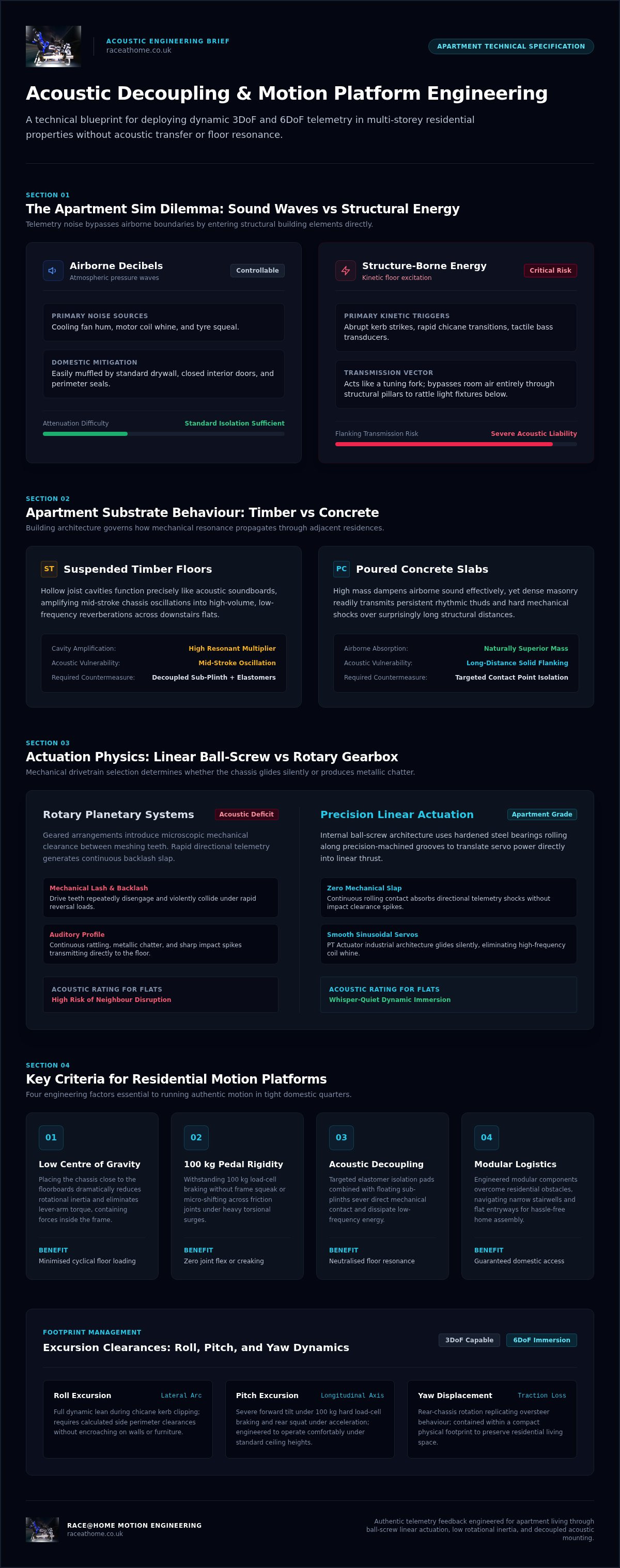
Stopping noise complaints requires separating airborne decibels from structure-borne mechanical energy. Airborne motor whine and actuator hum are easily muffled by drywall and standard interior doors. Structure-borne vibration, however, travels like a tuning fork against your building's frame. Abrupt kerb strikes and tactile bass transducers inject intense, low-frequency acoustic energy straight into solid surfaces. Without targeted vibration isolation, that kinetic energy bypasses room air entirely, flanking through structural pillars to rattle light fixtures in the flat below. Sourcing a genuinely quiet motion simulator for apartment use begins by mastering these direct physical contact points.
Apartment Floor Construction: Concrete Slabs Versus Suspended Timber
Your building's architecture dictates your isolation strategy:
- Suspended timber floors: Hollow joist cavities act like acoustic soundboards, amplifying mid-stroke chassis oscillations into loud low-frequency resonances across neighbouring flats.
- Poured concrete slabs: Heavy concrete dampens airborne sound effectively, yet dense masonry readily transmits persistent rhythmic thuds over surprisingly long distances.
Selecting the right hardware architecture prevents neighbour disputes before they start. If your platform sits close to the floorboards with a minimal centre of gravity, you dramatically reduce rotational inertia, keeping kinetic forces contained within the chassis rather than reverberating through your home's foundations.
Acoustic Engineering: What Makes a Motion Platform Truly Quiet?
A dense foam mat can't compensate for noisy mechanical components. True silence begins at the drawing board, governed by rigorous principles of acoustical engineering rather than aftermarket band-aids. Operational noise stems from two internal sources: mechanical lash within the drivetrain and harmonic resonance vibrating through the frame. When precision servo drives control motor positioning via smooth sinusoidal communication, they eliminate harsh electrical coil whine and high-frequency buzzing. The mechanical drive architecture itself dictates whether your rig whispers or rattles.
Linear Servo Actuation Versus Rotary Gearbox Systems
Many commercial simulators rely on rotary planetary gearboxes. While cost-effective, geared systems introduce microscopic clearance between meshing teeth. Under rapid directional changes, this backlash generates continuous rattling and metallic chatter as the drive teeth repeatedly engage and reverse under load.
In contrast, precision linear actuators operate via internal ball screws. Hardened steel bearings roll smoothly along precision-machined grooves, converting rotational servo power into linear thrust without mechanical slap. Industrial linear systems, such as PT Actuator hardware, glide almost silently while reacting instantly to real-time telemetry. By absorbing directional shocks through direct linear motion, they stop sharp impact spikes before acoustic energy reaches your living room floor, making them indispensable for an authentic, quiet motion simulator for apartment living.
Chassis Rigidity and Elimination of Frame Squeak
Cockpit sound profiles involve more than just motors. When you stamp on a 100 kg load-cell brake pedal whilst pitch actuators tilt the frame, tremendous torsional forces surge through the chassis. Standard modular aluminium extrusion cockpits rely on friction plates and drop-in nuts. Under sustained dynamic loads, these joints micro-shift, producing high-pitched creaks and groans that easily pierce through domestic flat partitions.
Eliminating frame flex requires high-grade materials and exceptional torsional rigidity. Hand-welded structural steel foundations withstand intense rotational stress without flexing or twisting, guaranteeing tight mechanical tolerances over years of continuous racing. If you want zero-compromise immersion that remains utterly silent through violent kerb strikes, exploring purpose-engineered chassis from Race@Home ensures your dynamic hardware stays as quiet as a static rig.
Key Criteria When Buying an Apartment-Friendly Motion Rig
Specifying a dynamic platform for flat living requires looking beyond peak acceleration numbers. While marketing materials frequently spotlight raw stroke length, residential installations demand strict attention to spatial geometry and operational manners. Sourcing the ideal quiet motion simulator for apartment spaces means evaluating how physical hardware behaves within tight architectural boundaries. As detailed in our comprehensive sim racing motion rig buyer's guide, marrying authentic tactile feedback with residential packaging separates seamless daily driving from an unmanageable living room monolith.
Centre of Gravity and Vertical Profile Constraints
Tall actuator columns elevate your seating position upwards by 30 to 50 centimetres. In modern flats with standard 2.4-metre ceilings, excessive base height forces your head dangerously close to overhead light fixtures while creating major clearance issues for integrated monitor stands. More importantly, keeping the centre of gravity low fundamentally reduces lateral leverage. A low-slung chassis contains yaw and sway forces close to the floor plane, minimising torque transfer and preserving room proportions without visual clutter.
Software Telemetry Tuning and Smooth Velocity Curves
Hardware accounts for only half the acoustic equation; intelligent telemetry processing handles the rest. Aggressive, square-wave software cues cause actuators to bottom out or knock against end stops. Advanced motion software applies smooth velocity smoothing and low-pass filtering, rounding off harsh telemetry peaks without muting kerb strikes or traction loss nuances. Custom night profiles let you adjust response curves instantly, reducing mechanical excursion to satisfy typical residential quiet-hour thresholds between 45 and 55 dB.
Delivery Logistics and Domestic Access Points
Standard building partitions often boast a decent Sound Transmission Class (STC) rating, but getting a chassis through the front door remains a significant hurdle. Before committing to a rig, evaluate your flat's physical access criteria:
- Modular architecture: Avoid single-piece, pre-welded steel spaceframes that won't clear narrow staircase turns or residential lift doors.
- Doorway clearances: Choose sub-assemblies designed to slip effortlessly through standard 750 mm domestic door frames.
- Rapid assembly: Prioritise bolt-together systems that assemble in under an hour, sparing your neighbours the nuisance of prolonged drilling or heavy hammering.
Carefully measuring your static footprint alongside the dynamic excursion envelope ensures your rig delivers true high-end immersion without encroaching on daily domestic life.
Apartment Acoustic Decoupling: How to Isolate Your Motion Platform
Even the smoothest linear actuators produce kinetic inertia during rapid weight transfers. Installing a quiet motion simulator for apartment use requires decoupling the chassis from the sub-floor through deliberate mechanical isolation. Without proper dampening, the physical contact patch between your simulator and the floor acts as an open bridge for kinetic resonance. Managing this mechanical transmission requires a systematic, four-step approach:
- Calculate your combined rig and driver weight to select correctly rated industrial elastomer pads.
- Build a floating sub-plinth if you race over hollow timber joists to diffuse concentrated point loads.
- Tune tactile transducers to contain vibrational cues within the seat rather than the chassis.
- Ensure clean, stable electrical delivery to prevent transformer hum and high-current ground loops.
Industrial Elastomers and Multi-Layer Decoupling Mats
Interlocking EVA foam gym tiles might protect hardwood from scratches, but they fail under sustained loads. When subjected to the static weight of a sim cockpit plus dynamic driver inputs, cheap foam compresses into a solid block, losing all decoupling elasticity.
Instead, rely on engineered materials such as closed-cell polyurethane or viscoelastic Sorbothane pads calibrated specifically to your setup's gross mass. If you race over suspended timber floors, construct a sandwich-style floating sub-plinth using alternating layers of high-density board and dense rubber sheeting. Combining materials with disparate acoustic densities interrupts harmonic waveforms, dissipating kinetic energy as heat rather than letting it telegraph downstairs.
Tactile Transducer and Shaker Management
Tactile shakers bring engine RPM and ABS pulses to life, but unmanaged haptics can quickly ruin your relationship with downstairs tenants. Bolting transducers directly onto outer chassis rails turns the entire cockpit into a massive vibration amplifier. Instead, isolate tactile units directly to the seat shell using heavy-duty rubber isolation bobbins, keeping the energy focused on your body.
Software settings require equal care. Apply a steep high-pass filter in your telemetry mixer to cap frequencies below forty hertz, cutting deep structural rumbles whilst preserving crisp kerb and road texture details. For component recommendations, explore our sim racing accessories guide to match isolation mounts with your seat. When you're ready to engineer a silent, high-performance racing setup in your flat, explore custom LowSlider motion platforms at Race@Home to configure a low-profile rig tailored to your space.
Quiet, Compact Immersion: Race@Home LowSlider Solutions
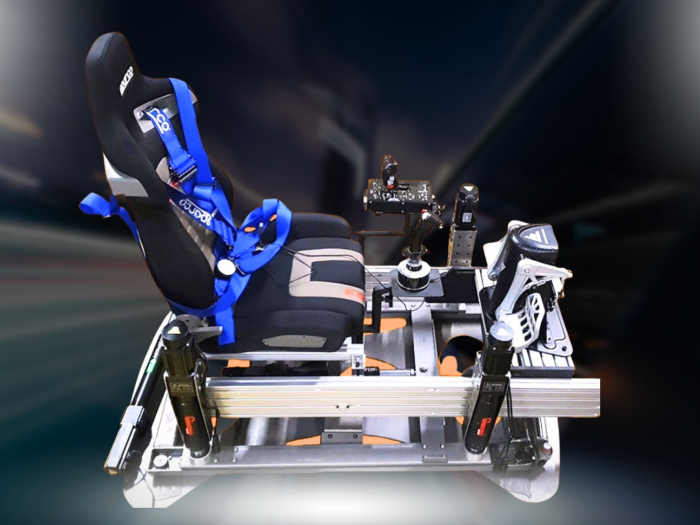
Traditional motion platforms rely on towering actuator uprights that dominate living spaces and act like acoustic megaphones. Race@Home tackles this engineering bottleneck directly through the proprietary LowSlider architecture. Hand-built to order in the UK using premium architectural-grade materials, these systems abandon clumsy, elevated geometry. Instead, they position mechanical leverage horizontally, delivering a whisper-quiet motion simulator for apartment living that fits unobtrusively into modern residential flats.
LowSlider 3DoF: The Minimalist Apartment Solution
The LowSlider 3DoF motion platform provides immediate physical clarity for drivers dealing with strict floor-space boundaries. It reproduces vital pitch, roll, and heave telemetry whilst preserving an ultra-low chassis height, keeping your driving position identical to a static aluminium cockpit. Operating quietly within a discreet physical profile, it lets you tackle tight corners and heavy kerb strikes in multi-purpose spare rooms without raising eyebrows or dominating your flat's layout.
LowSlider 6 DOF Twin-Traction-Loss: Complete Realism Without the Racket
Racers refusing to compromise on tactile immersion can upgrade to the LowSlider 6 DOF Twin-Traction-Loss Motion Platform. This flagship design introduces independent front and rear yaw, delivering genuine oversteer and understeer cues alongside surge, sway, heave, roll, and pitch. As explained in our comprehensive guide to 6 DOF motion simulators for home rigs, full multi-axis fidelity rarely fits residential limits. Here, integrated high-precision PT Actuator linear technology delivers silent, instantaneous mechanical movement. By keeping the chassis mass centred mere inches off the floorboards, lateral inertia dissipates cleanly across the platform rather than pulsing through your sub-floor.
Effortless Four-Piece Setup and Worldwide Delivery
Getting heavy sim hardware up three flights of stairs often ends in scuffed skirting boards and immense frustration. Race@Home solves domestic access limitations with practical modular construction:
- Modular packaging: Every rig ships internationally in four manageable, pre-assembled sections.
- Access-ready sizing: Individual modules glide through standard doorways, narrow stairwells, and compact apartment lifts.
- Rapid assembly: The entire mechanical framework bolts together in under an hour using standard hand tools.
You don't need a sprawling detached garage or commercial warehouse to experience true six-axis immersion. Explore your bespoke setup through our buy motion simulator UK guide to discover how purpose-built engineering unlocks authentic, neighbour-friendly motion racing at home.
Transform Your Flat Into a Professional Sim Racing Paddock
Living in a residential flat no longer forces you to sacrifice the physical reality of dynamic motorsport. As we've explored, controlling kinetic floor transmission comes down to fundamental physics rather than thick foam mats. Combining targeted elastomer decoupling with smooth linear drive technology eliminates the harsh vibrations that disrupt neighbours below. By pairing intelligent telemetry smoothing with a low centre of gravity, you contain mechanical energy where it belongs: inside the driver's seat.
Securing an authentic, quiet motion simulator for apartment living simply requires purpose-built engineering. Race@Home designs platforms specifically for close-quarters domestic life. Featuring an ultra-low profile chassis and precision PT Actuator linear mechanics, each system delivers rapid, silent response without high-altitude frame sway. Shipped across the globe in four modular sections, the entire platform slips through compact flat doorways and bolts together in under an hour. You don't need a suburban workshop to chase the apex in full motion. Explore the whisper-quiet LowSlider platform for your home and experience uncompromised multi-axis realism from your flat today.
Frequently Asked Questions
Can my downstairs neighbours hear a quiet motion simulator running?
Downstairs neighbours won't hear a properly isolated platform running during normal domestic hours. Airborne actuator noise remains minimal, whilst targeted elastomeric decoupling absorbs kinetic energy before it enters the sub-floor. If you deploy a purpose-built quiet motion simulator for apartment environments alongside tuned telemetry profiles, your operational sound stays comfortably below typical 45 to 55 dB residential quiet-hour thresholds.
How much ceiling height do I need for an apartment motion rig?
Standard domestic ceiling heights of 2.4 metres provide ample vertical clearance for low-slung platforms. Traditional tall motion frames can push your head uncomfortably close to overhead lights during full pitch or heave excursions. In contrast, low-profile chassis engineering keeps seat elevation identical to a static cockpit, ensuring generous overhead space whether you race with an ultra-wide monitor or a VR headset.
Are linear servo actuators quieter than gear-driven motion systems?
Linear servo actuators operate far more quietly than traditional rotary planetary gearboxes. Geared systems rely on interlocking mechanical teeth that inevitably produce backlash, rattling, and metallic chatter during abrupt load reversals. Precision linear actuators utilise internal ball screws that glide smoothly on continuous raceways, eliminating mechanical lash and delivering near-silent stroke transitions even under aggressive cornering loads.
Can a motion platform be used safely on carpeted or hardwood apartment floors?
You can safely run dynamic platforms on both carpeted and hardwood surfaces provided you distribute the chassis weight properly. Hardwood floors require dense elastomer pucks beneath the contact feet to prevent surface scuffing and acoustic bridging. On carpet, placing a rigid sub-board beneath your decoupling pads creates a stable foundation, keeping the platform level without permanently crushing your carpet pile.
Will an apartment electrical ring circuit handle a multi-axis motion simulator?
A standard domestic ring circuit easily handles high-performance motion platforms without tripping breakers or overloading supply lines. Modern linear actuators rely on efficient servo drives that draw modest continuous wattage during standard racing sessions, with brief dynamic spikes buffered by onboard capacitors. Running your motion platform alongside a high-spec gaming PC and peripherals requires only standard domestic wall sockets.
How do I isolate tactile bass shakers from vibrating through the floor?
Isolating tactile transducers requires bolting them directly to the seat rather than the outer frame rails. Placing heavy-duty rubber isolation bobbins between the seat brackets and the chassis keeps tactile rumble concentrated on your body. Additionally, filtering out sub-bass frequencies below forty hertz stops low-end energy from conducting into timber joists, completing an effective quiet motion simulator for apartment living.
Can the LowSlider motion platform fit through standard domestic apartment doorways?
The LowSlider platform easily navigates standard 750 mm domestic doorways, narrow hallways, and residential lifts. Hand-built in the UK, each rig ships internationally in four modular, pre-assembled sections rather than a cumbersome monolithic frame. This modular packaging allows one person to guide components through tight entrances effortlessly, completing mechanical assembly in under an hour using basic hand tools.


