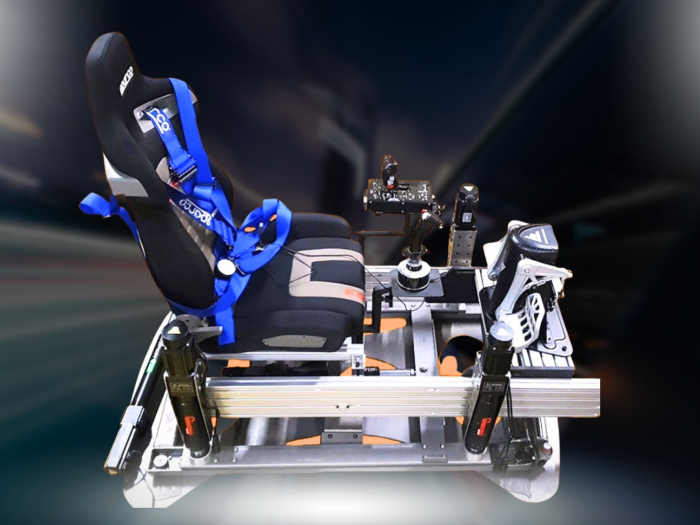

The most immersive professional sim racing simulator isn't found in a commercial arcade or a professional driver's training facility; it's the one you can finally fit inside your home office. You've likely felt the frustration of visual-vestibular disconnect, that nauseating sensation where your eyes see a hairpin turn whilst your body remains static. It's a common hurdle that often turns a high-stakes race into a struggle against motion sickness. We understand that you want the visceral thrill of the track without the industrial bulk or the overwhelming technical complexity of a DIY mechanical nightmare.
This 2026 guide reveals how to bridge the gap between digital telemetry and physical reality using a professional-grade motion setup engineered specifically for the home environment. You'll discover how 6 DOF motion delivers total immersion by translating every kerb and gear shift into tangible sensations. We will explore how modern engineering allows for a compact footprint and quick assembly, ensuring you spend less time turning spanners and more time hitting apexes. Prepare to transform your digital hobby into a high-fidelity sensory experience that fits perfectly within your personal space.
Key Takeaways
- Learn how a professional sim racing simulator has evolved into a high-fidelity training tool that prioritises precise telemetry translation over mere aesthetic cockpit looks.
- Understand the science behind 6 Degrees of Freedom and why capturing traction loss is the secret to sensing oversteer before it ruins your lap time.
- Discover how ultra-low profile engineering eliminates the need for bulky industrial rigs, allowing for professional-grade realism within a compact home office footprint.
- Identify the essential hardware ecosystem, including the role of high-fidelity VR headsets in removing the final barrier between you and the digital track.
- Explore the advantages of hand-built British craftsmanship and modular designs that simplify assembly without compromising on mechanical tolerances or longevity.
Defining the Professional Sim Racing Simulator in 2026
In 2026, the definition of a professional sim racing simulator has undergone a radical transformation. It has moved beyond the category of high-end gaming peripherals to become a legitimate professional training tool. This evolution is driven by the precision of modern physics engines and the ability of hardware to translate that data into physical force. Whilst many entry-level setups focus on the aesthetic look of a cockpit, a true professional rig prioritises high-fidelity sensory feedback. It's about how the machine communicates the road surface, the tyre load, and the chassis dynamics to the driver's nervous system. British engineering is currently at the forefront of this niche, proving that professional-grade realism doesn't require an industrial-sized footprint that takes over an entire room.
The core of this experience is the motion simulator technology, specifically systems utilising 6 Degrees of Freedom (6 DOF). These platforms allow the driver to experience heave, pitch, roll, yaw, surge, and sway in a way that mimics genuine vehicle dynamics. By compacting this technology, UK-based specialists have made it possible to achieve elite-level training within a standard home office or spare room.
Telemetry: The Heart of Professional Simulation
Professional simulation relies on the seamless conversion of software telemetry into mechanical action. This process must occur with near-zero latency; if the physical movement lags behind the visual input, the brain rejects the experience. High-quality systems focus on a superior signal-to-noise ratio. This means the actuators filter out irrelevant vibration and instead deliver clear, actionable data about the car's behaviour. Telemetry is the bridge between virtual physics and physical sensation. By focusing on the purity of this data stream, drivers can receive coaching that translates directly to real-world track performance.
Static vs. Motion: The Professional Performance Gap
Static rigs, regardless of how expensive their pedals or wheels are, possess a fundamental flaw: they cannot teach weight transfer. In a real car, you feel the nose dive under braking and the rear squat under acceleration. Without these cues, your brain relies solely on visual markers, which slows down reaction times. A professional sim racing simulator uses motion to develop muscle memory for tyre slip limits and oversteer. Consistency is the hallmark of a professional driver. Motion provides the vestibular feedback required to catch a slide before it's visible on the screen. There's a common myth amongst novices that motion is just for "fun." In reality, poorly calibrated "motion for the sake of motion" rigs actually hinder performance. A professional setup, such as the LowSlider 6 DOF, uses nuanced movement to provide a competitive advantage, ensuring every millimetre of actuator travel serves a specific purpose in the training cycle.
The Science of 6 Degrees of Freedom: Why Motion Matters
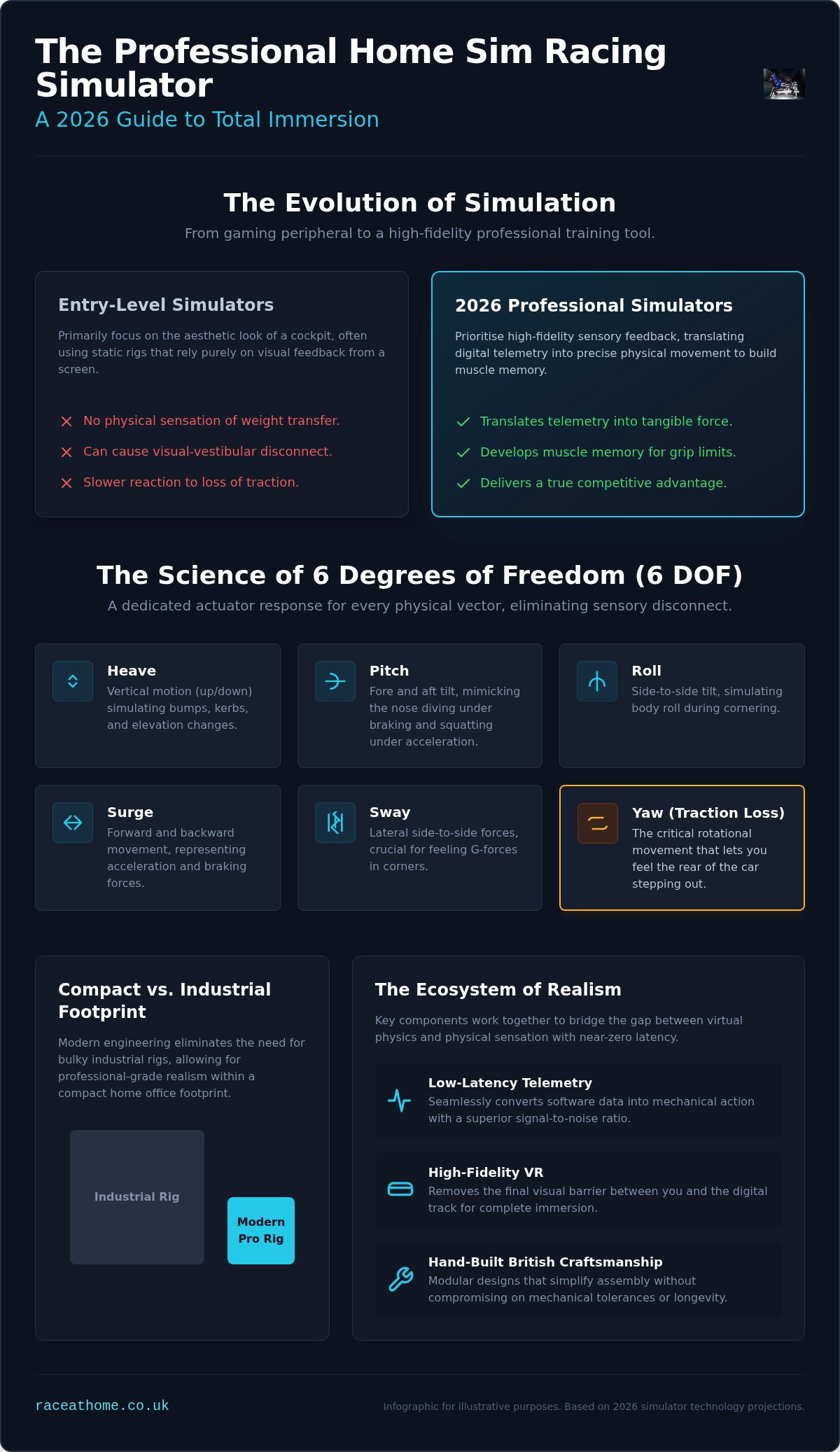
A true professional sim racing simulator is defined by its ability to replicate the six fundamental ways a vehicle moves through space. These are Heave (vertical), Pitch (fore and aft tilt), Roll (side to side tilt), Yaw (rotation), Surge (acceleration and braking), and Sway (lateral g-forces). Whilst entry-level 3DOF rigs often attempt to mask their limitations by using "ghost" sensations, such as using roll to mimic lateral sway, a 6 DOF system provides a dedicated actuator response for every physical vector. This level of fidelity is essential for professional training. It ensures that the feedback your body receives matches the visual data perfectly, eliminating the sensory disconnect that causes motion sickness. Achieving this requires meticulous engineering to synchronise six high-speed actuators without mechanical interference or latency.
Yaw and Surge: Sensing the Limit of Grip
The inclusion of a twin traction loss motion platform is perhaps the most significant leap for serious racers. In high-performance GT3 or Formula simulation, the ability to sense the rear axle's behaviour is non-negotiable. Yaw movement allows you to feel the back end of the car stepping out long before your eyes register the slide on the screen. Surge simulation complements this by providing the visceral push and pull of threshold braking and launch control. It allows you to practice the delicate balance of grip during a standing start or a heavy deceleration zone. This sensory data creates a complete picture of the car's limit of grip, enabling you to drive with a level of aggression and precision that static rigs simply cannot support.
Heave and Pitch: Real-World Vertical G-Forces
Vertical g-forces provide the grit and texture of the racing experience. Pitch is vital for understanding weight transfer; you feel the nose-dive as you trail-brake into a corner and the rear squat as you bury the throttle on the exit. Heave brings the track surface to life, simulating everything from subtle elevation changes to the violent compression at the bottom of a steep hill. Heave actuators must react in milliseconds to simulate track texture and the sharp, percussive jolt of a kerb strike accurately. This verticality transforms the simulator from a game into a living machine. For those ready to bridge the gap between telemetry and reality, investing in a professional sim racing simulator from a specialist UK manufacturer ensures that every degree of movement serves a training purpose.
Compact vs. Industrial: Navigating Professional Rig Footprints
Many enthusiasts fall into the 'Industrial Trap' when selecting a professional sim racing simulator. They assume that professional-grade realism requires a sprawling, heavy-duty frame that resembles a piece of factory machinery. This is a misconception that often leads to rigs being relegated to garages or dedicated outbuildings. In a residential setting, excessive bulk is often a sign of inefficient engineering. Larger frames can actually introduce unwanted leverage and flex, which muddies the precision of the motion feedback you receive through the seat. British engineering has pioneered a different path, focusing on high-density rigidity within a footprint that respects the constraints of a standard home office or spare room.
Traditional D-Box style frames often sit significantly higher off the ground, raising the centre of gravity and increasing the mechanical strain on the actuators. By contrast, the proprietary LowSlider design focuses on an ultra-low profile. This ensures that every millimetre of movement is translated directly to the driver's body rather than being lost to frame oscillation. You don't need a warehouse to experience elite-level training; you need a rig that prioritises stability and material science over sheer physical size.
The LowSlider Design Philosophy
Lowering the centre of gravity is the cornerstone of our design. When the mass of the driver and the equipment is kept close to the floor, the motion fidelity becomes significantly sharper. This reduces the work the actuators must perform to overcome inertia, leading to faster response times and greater longevity. Choosing a low profile motion sim rig also provides a major ergonomic benefit: ease of entry and exit. You don't need to climb into the cockpit like a piece of heavy plant machinery. The LowSlider 6 DOF platform is engineered to fit into a space no larger than a standard static rig, proving that professional performance can be compact.
Noise and Vibration Management for Home Use
A professional sim racing simulator should be felt, not heard by everyone else in the house. Older hydraulic systems were notorious for their audible whine and heat generation. Modern professional setups utilise high-precision PT Actuators, which are remarkably quiet whilst delivering immense force. To manage vibration in a home environment, we focus on structural isolation. Using high-density damping solutions between the rig and the floorboards ensures that the energy of a kerb strike or a gear shift stays within the cockpit. This creates a 'stealth' professional rig that allows for high-performance training at any hour without disrupting the household.
Essential Hardware: VR, Pedals, and the Ecosystem of Realism
A professional sim racing simulator is only as effective as the weakest link in its hardware chain. Whilst the motion platform provides the visceral foundation, the experience remains incomplete without a high-fidelity ecosystem of peripherals. You need every component to speak the same language of precision. From the resistance in the brake pedal to the peripheral vision in your headset, each element must align with the physical feedback of the chassis. Integrating high-end sim racing accessories ensures that the digital data from the simulation translates into a cohesive sensory reality.
VR Immersion: The Pimax Advantage
The shift from triple monitors to high-fidelity VR is the final step in eliminating the 'flat screen' barrier. A Pimax VR motion simulator setup offers a wide Field of View (FOV) that mimics human peripheral vision. This is critical for gauging speed and distance accurately. When your visual FOV aligns perfectly with the physical 6 DOF movement, the brain's vestibular system stays in sync. This synchronisation drastically reduces motion sickness, allowing for longer, more intense training sessions. You also need extreme resolution to read dashboard telemetry and track markers clearly whilst travelling at high speeds. This clarity ensures that your eyes and body aren't fighting different sets of data.
Direct Drive and Pedals: The Tactile Connection
Your primary touchpoints are the wheel and pedals. A professional rig is fundamentally incomplete without a direct drive wheel base capable of delivering at least 20Nm of torque. This level of power isn't just about strength; it's about the nuance of the steering rack's feedback. You'll feel the front tyres scrubbing across the tarmac as the motion platform tilts the chassis. Similarly, hydraulic pedals are essential for simulating realistic brake pressure. Unlike basic spring-based pedals, hydraulic systems rely on pressure rather than travel. This allows you to develop the same muscle memory used in a real GT3 car. When these components work in harmony with the motion actuators, the result is a professional sim racing simulator that feels like a living, breathing machine.
The LowSlider Advantage: Professional Performance, Hand-Built in the UK
A professional sim racing simulator is more than a collection of high-end electronics; it is a precision-engineered instrument that must withstand immense mechanical stress. Choosing a hand-built rig from a UK specialist ensures a level of structural integrity that mass-produced alternatives simply cannot match. Every LowSlider platform is constructed to order with exacting tolerances, ensuring that the motion feedback remains crisp and accurate over years of heavy use. This dedication to British engineering excellence means your investment is protected by superior material choices and rigorous quality control. We don't just assemble parts; we craft a foundation for elite-level performance.
Longevity and future-proofing are central to our design philosophy. As simulation software evolves, your hardware must be capable of adapting. The LowSlider system is designed to be modular, allowing for easy upgrades and the addition of new accessories as your training requirements grow. We ship these professional systems worldwide, ensuring that distance is no barrier to accessing world-class motion technology. Whether you are in London or Los Angeles, your rig arrives with the same guarantee of craftsmanship and reliability.
One-Hour Assembly: From Crate to Cockpit
We have eliminated the 'assembly dread' that typically accompanies high-end motion platforms. Most professional rigs arrive as a daunting 'bag of bolts' that can take an entire weekend to organise and build. By contrast, our self assembly motion simulator arrives in just four pre-assembled modules. This modular approach allows for a sub-one-hour setup time, moving you from crate to cockpit with minimal friction. Every unit is fully tested by our engineers before it is crated, providing the confidence that your rig will perform perfectly from the first corner. You spend less time following complex manuals and more time refining your technique on the track.
Your Gateway to Professional Sim Racing
Choosing the right platform depends on your specific training objectives. The LowSlider 3DoF offers an incredible entry point into motion, providing essential pitch, roll, and heave data. However, for those seeking the ultimate in realism, the LowSlider 6 DOF Twin-Traction-Loss Motion Platform provides the complete sensory picture required for competitive racing. When conducting a sim racing motion rig worth it analysis, the value lies in the translation of digital telemetry into tangible driver improvement. A professional sim racing simulator is an investment in your skill, consistency, and immersion. Explore the LowSlider 6 DOF and professionalise your home setup today.
Elevate Your Racing to Professional Standards
The transition from a static setup to a professional sim racing simulator is a transformative leap in driver development. You now understand how 6 Degrees of Freedom and twin-traction-loss technology provide the essential telemetry required to master weight transfer and tyre slip limits. By choosing an ultra-low profile design, you ensure that this elite-level realism fits seamlessly into your home environment without the need for industrial-scale modifications. Precision is no longer a luxury; it's a requirement for those who demand total immersion.
Achieving this level of fidelity requires a synergy between high-end hardware and meticulous British engineering. Our platforms are hand-built in the UK to exacting standards, ensuring that every actuator movement serves a specific training purpose. We've simplified the logistics of high-end motion with global shipping in four pre-assembled pieces, allowing for an under 1-hour assembly time. It's time to stop fighting visual-vestibular disconnect and start feeling the track exactly as the physics intended. Build your bespoke professional motion rig with Race@Home and experience the ultimate evolution of the hobby. Your fastest lap is waiting to be discovered.
Frequently Asked Questions
What is the difference between a gaming rig and a professional sim racing simulator?
A professional sim racing simulator is distinguished by its ability to accurately translate digital telemetry into physical force. Whilst a gaming rig might prioritise aesthetic cockpit looks or basic vibration, a professional system uses high-fidelity actuators to replicate vehicle dynamics like traction loss and weight transfer. This precision transforms the rig from a leisure device into a legitimate training tool that builds muscle memory through accurate sensory feedback.
How much space do I actually need for a 6 DOF motion platform at home?
You don't need a dedicated warehouse for a high-end setup; the LowSlider 6 DOF platform is engineered for a compact footprint. It is designed to fit comfortably within a standard British spare room or home office. Because of its ultra-low profile design, the physical space required is comparable to a traditional static rig, ensuring that professional-grade motion remains accessible to enthusiasts without unlimited floor space.
Does a motion simulator really help improve real-world lap times?
Motion simulators significantly improve consistency and lap times by providing the vestibular cues necessary to sense a car's limit of grip. By feeling traction loss through the yaw axis, you can catch oversteer much faster than relying on visual data alone. This real-world translation of physics helps drivers develop a deeper understanding of weight transfer, which translates directly to improved performance on a physical track.
Is the LowSlider motion platform compatible with all sim racing software?
The LowSlider motion platform is designed to be highly versatile and integrates seamlessly with all major sim racing software titles. This includes industry standards such as iRacing, Assetto Corsa Competizione, and rFactor 2. By utilising established telemetry protocols, the system ensures that every bump, kerb strike, and gear shift is communicated accurately from the software to the hardware without complex manual configuration.
How difficult is it to assemble a professional motion rig by myself?
Assembling a professional motion rig is straightforward thanks to our proprietary four-piece modular design. We have eliminated the "bag of bolts" approach that often leads to assembly dread. Your rig arrives in four pre-assembled sections that can be fully commissioned in under one hour. This ensures that you spend your time racing rather than navigating complex engineering manuals or sourcing missing fasteners.
Can a motion platform cause motion sickness, and how can I prevent it?
Motion sickness in simulation typically stems from a visual-vestibular disconnect where your eyes see movement that your body doesn't feel. A 6 DOF motion platform actually helps prevent this by providing the physical sensations that match your visual inputs. Using high-fidelity Pimax VR headsets further reduces discomfort by ensuring your field of view and physical motion are perfectly synchronised.
What are the power requirements for a professional 6 DOF sim rig?
A professional 6 DOF sim rig is designed to operate on standard domestic power supplies, though it is advisable to use dedicated wall sockets. The high-performance actuators and the accompanying gaming PC require stable power to maintain low-latency feedback. Our systems are engineered to be energy-efficient whilst delivering the immense torque and speed required to simulate realistic vertical g-forces and chassis movements accurately.
Do you ship your professional simulators to customers outside of the UK?
Yes, we provide global shipping for all our hand-built motion platforms. Every professional sim racing simulator is crated securely in four easy-to-assemble pieces to ensure it reaches you in perfect condition, regardless of your location. Our logistics partners are experienced in handling high-end engineering equipment, ensuring that your gateway to professional-level immersion is delivered directly to your door with minimal fuss.


