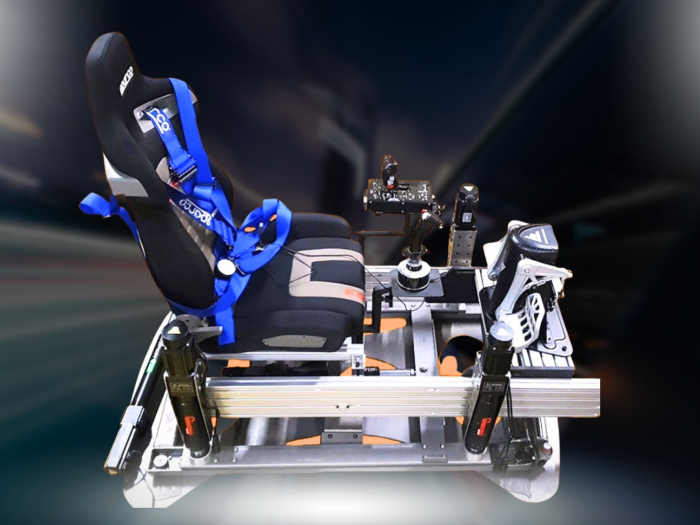

The most advanced visual setup in the world remains a mere video game if your body stays anchored in a static chair whilst your eyes witness a 150mph corner. You've likely felt the frustration of overdriving or losing the rear end simply because that critical "seat-of-the-pants" feel was missing from your rig. Achieving authentic sim racing g-force feedback isn't about mere haptic vibration; it's a sophisticated engineering feat that translates digital telemetry into the sustained physical pressure that defines professional-grade motorsport.
In this guide, we'll delve into the science of how high-end motion platforms, such as the LowSlider 6 DOF, bridge the gap between software data and visceral reality. You'll learn to differentiate between simple vibrations and true G-force simulation, understanding how high-speed PT Actuators and twin-traction-loss systems allow you to sense the limit of grip before it is too late. We will break down the physics of physical immersion and help you identify the hardware necessary to transform your home setup into a precision-engineered training tool that rewards every ounce of your driver intuition.
Key Takeaways
- Understand how digital telemetry from titles like iRacing is converted into tangible physical pressure, moving beyond simple wheel-based force feedback.
- Learn why low-latency PT Actuators are essential for accurate sim racing g-force feedback, providing the response speed required for professional-grade realism.
- Discover the critical distinction between transient bumps and sustained cornering forces to ensure your rig provides a true "seat-of-the-pants" feel.
- Explore how twin-traction-loss systems simulate lateral G-forces, allowing you to sense and correct oversteer before your rear tyres lose grip.
- Identify the ideal hardware configurations, including the benefits of pairing 6 DOF motion with Pimax VR headsets for total sensory immersion.
What is Sim Racing G-Force Feedback?
Sim racing has evolved far beyond pixels and plastic wheels. To understand What is G-Force in a simulation context, we must look at how digital telemetry translates into physical acceleration. Whilst a standard steering wheel provides Force Feedback (FFB), sim racing g-force feedback refers to the sustained physical forces that act upon your entire body during acceleration, braking, and cornering. It's the difference between seeing a car turn and feeling the weight of that car shift beneath you. It's about moving from a visual experience to a visceral one.
Your brain is a master of sensory integration. When you enter a high-speed corner in a simulator, your eyes see the apex and your hands feel the steering rack tighten. However, if your inner ear, the vestibular system, doesn't detect a corresponding shift in balance, a "sensory mismatch" occurs. This often leads to motion sickness in VR or, at the very least, a lack of immersion that forces you to rely solely on visual cues. Physical feedback bridges this gap, providing the natural cues your brain needs to process speed and grip levels accurately without second-guessing the software.
The Three Pillars of Physical Immersion
True realism is built on three distinct layers of feedback. First is Tactile or Haptic feedback, which covers high-frequency vibrations such as engine revs, gear shifts, and the harsh rattle of kerbs. Second is Kinematic feedback, which involves the actual displacement of your cockpit through space; pitch during braking, roll during cornering, and yaw during a slide. The third, and most elusive, is Sustained Pressure. This is the visceral sensation of being pinned into your bucket seat during a heavy braking zone or feeling your body press against the side bolster during a long, high-speed sweeper. Without all three, the simulation remains incomplete.
Beyond the Steering Wheel: Why Motion Matters
Many drivers mistakenly believe that a high-end Direct Drive wheel is enough for total immersion. It isn't. Your steering wheel is a window into what the front tyres are doing, but it tells you very little about the behaviour of the rear axle. Motion platforms, like the LowSlider 6 DOF, provide that essential "seat-of-the-pants" feel. By simulating the chassis' movement, a motion rig allows you to identify oversteer the microsecond the rear tyres lose traction; this often happens before the visual lag of your monitor even registers the slide.
This physical connection significantly reduces your cognitive load. You stop "thinking" about the car's position and start "feeling" its balance. When your body receives these cues naturally, your muscle memory takes over, allowing you to react faster and more consistently. In the high-stakes environment of professional-grade sim racing, that split-second physical warning is the difference between a podium finish and a trip to the tyre wall.
The Physics of Feedback: How Actuators Create G-Forces
The raw physics of a racing title like iRacing or Assetto Corsa Competizione (ACC) exists as a constant stream of high-fidelity numbers. To transform these numbers into authentic sim racing g-force feedback, a motion platform must process this data with surgical precision. This isn't about random movement; it's about the mathematical translation of mass, velocity, and friction into physical displacement. When your car hits a bump or dives into a corner, the software calculates the exact force required to move the chassis, ensuring your body reacts just as it would in a real cockpit.
Telemetry to Motion: The Software Bridge
Before an actuator moves a single millimetre, specialised software must interpret the game's output. Telemetry is the digital heartbeat of a motion simulator. This data stream includes everything from tyre slip angles to suspension compression. However, a home rig cannot move three feet to simulate a long corner, so software uses motion cueing algorithms to scale these forces. By filtering the raw physics, the system provides "washout" cues that trick your brain into feeling sustained acceleration within a limited physical space. This clever scaling ensures you feel the weight shift without the rig hitting its mechanical limits.
The Role of PT Actuators in G-Force Precision
The hardware responsible for this translation is the actuator. High-end rigs, such as the LowSlider 6 DOF, utilise industrial-grade PT Actuators because they offer the low latency required for realism. If the feedback arrives even a few milliseconds late, the illusion breaks and your brain rejects the sensation. Actuator stroke, or travel, determines how much "room" the rig has to simulate sustained loads. A longer stroke allows for more dramatic pitch and roll, whilst high-speed response ensures that every kerb strike and gear shift feels crisp and immediate. If you are looking to refine your setup, choosing the right sim racing accessories can help bridge the gap between a standard rig and a professional motion platform.
A 6 Degrees of Freedom (6 DOF) system provides the most comprehensive sim racing g-force feedback by moving across all three linear axes (heave, sway, surge) and rotating around them (pitch, roll, yaw). This complexity is vital for simulating vertical Gs. Think of the compression at the bottom of Eau Rouge at Spa-Francorchamps; as the car bottoms out, a 6 DOF rig uses "heave" to press your body into the seat, replicating the massive vertical load. Without this capability, you lose the sense of elevation and track topography that makes world-class circuits so challenging. To experience this level of precision in a compact footprint, exploring the hand-built motion platforms from Race@Home is the logical next step for any serious enthusiast.
Sustained vs. Transient Forces: The Realism Gap
A common misconception in the community is that all movement equals realism. It doesn't. Authentic sim racing g-force feedback relies on a delicate balance between transient and sustained forces. Transient forces are the high-frequency, short-duration cues that provide immediate tactical information. Think of the sharp jolt of a gear shift, the staccato rattle of a kerb, or the initial "bite" as you pitch the car into a corner. These cues are vital for reaction, but they only represent half of the physical story.
Sustained forces are the real challenge for any home rig. When you're holding a car on the limit through a long sweeper like Parabolica at Monza, your body expects constant, unwavering pressure. Motion platforms achieve this through "Washout" filters. Once the initial movement cue is delivered, the rig subtly returns to its neutral centre at a speed below your threshold of perception. This resets the actuators, allowing them to deliver the next physical cue without you ever realising the rig has moved. It's a sophisticated sleight of hand that keeps the immersion from breaking during long corners or heavy braking zones.
Gravity Lean: Tricking the Human Brain
Since a simulator cannot physically accelerate down a mile-long straight, it uses "Gravity Lean" to simulate sustained G-loadings. By tilting the entire cockpit, the rig uses the earth's own gravity to simulate lateral or longitudinal acceleration. If you're braking hard, the rig pitches forward; gravity then pulls your body into the harness, replicating the sensation of deceleration. The angle of the tilt is critical; too much and you feel like you're falling, too little and the sensation vanishes. Recent research into Deep Reinforcement Learning is currently being applied to these motion cueing algorithms, aiming to make these transitions even more seamless and predictive for the driver.
The Importance of a Compact, Low-Profile Design
The effectiveness of these forces depends heavily on the rig's physical architecture. The LowSlider design is a direct response to the "pendulum effect" found in taller, more cumbersome rigs. When a seat is mounted high above the actuators, the motion can feel exaggerated and sloppy. By keeping the centre of gravity ultra-low, the forces are translated directly to your body rather than being lost in the mechanical leverage of the platform. This results in a much crisper connection to the tarmac, allowing for a high G-force range within a compact footprint that fits easily into a home environment without sacrificing professional-grade fidelity.

Lateral Gs and the Power of Twin Traction Loss
Lateral G-force is the sideways pressure your body endures as the tyres fight to hold the line through a high-speed bend. In high-end setups, providing accurate sim racing g-force feedback means more than just tilting the seat; it requires the physical replication of the car's lateral displacement through space. Whilst many systems focus on pitch and roll, the addition of dedicated traction loss components is what truly bridges the gap between a simulator and a race car. It provides the essential data your brain needs to understand the car's relationship with the track surface.
Traction loss simulates the exact moment the rear tyres lose their grip on the tarmac. Most entry-level systems utilise a single pivot point, which often results in a sensation similar to a garden gate swinging open. This is a far cry from reality. A true "Twin-Traction-Loss" system, such as that found in the LowSlider range, moves both the front and rear of the rig independently. This creates a genuine "chassis slide" sensation, mimicking how a car actually drifts across the circuit. It allows you to feel the car "crab" sideways, providing a level of fidelity that a single-pivot system simply cannot match.
Sensing the Limit: The Competitive Edge
Sensing the limit of adhesion is what separates the enthusiasts from the professionals. When you can feel the rear of the car begin to rotate through your hips, you gain a psychological advantage. You stop reacting to what you see on the screen and start pre-empting the car's behaviour through physical intuition. Professional drivers use these lateral G-cues to refine their steering inputs, often making micro-corrections before a slide even becomes visible. This feedback loop is the most effective tool for improving consistency; it gives you the confidence to drive at 100% of the grip limit whilst providing the warning signs needed to save the car from a spin.
6 DOF: The Gold Standard for Lateral Realism
To achieve the gold standard of lateral realism, a rig must combine Sway (side-to-side movement) with Yaw (rotation). A 6 DOF motion simulator integrates these movements seamlessly, allowing the chassis to "float" and "bite" just like a real GT3 or formula car. The LowSlider 6 DOF platform is engineered specifically to deliver this high-fidelity feedback within a compact footprint, ensuring that every millimetre of lateral movement is purposeful and precise. If you are ready to master the limit of grip, exploring the LowSlider 6 DOF Twin-Traction-Loss Motion Platform is the logical next step for your professional home setup.
Building the Ultimate G-Force Setup at Home
The transition from abstract physics to a functional home cockpit is where many enthusiasts hesitate. However, creating a professional-grade environment for sim racing g-force feedback is now more accessible than ever. Your first decision rests on the degree of fidelity you require. Whilst a LowSlider 3DoF motion platform provides essential pitch, roll, and heave, stepping up to a 6 DOF system introduces the surge, sway, and yaw necessary for total spatial awareness. This choice often balances your available space against the desire for uncompromising physical realism.
To truly harness these forces, your ergonomics must be as precise as your hardware. A loose seat is the enemy of immersion. If your body moves independently of the rig, the subtler G-cues are lost in the mechanical noise. Utilising a proper racing bucket seat and a tightly adjusted four-point harness is essential; the harness acts as the physical conduit, pressing you into the seat during braking and pulling against you during acceleration. Once the hardware is set, software tuning allows you to refine the experience. You can customise motion profiles to distinguish between the sharp, violent snaps of a Formula car and the heavier, more progressive weight transfers of a GT3 machine; this attention to chassis dynamics is a core part of vehicle engineering, whether in a simulator or for heavy-duty agricultural equipment from farmtrac.escortskubota.com.
VR and Motion: The Final Frontier of Realism
Pimax VR Headsets and motion platforms are a natural synergy. When you pair high-fidelity motion with a 5K resolution and a wide Field of View (FOV), your brain no longer perceives a simulation; it perceives a reality. The wide FOV is critical for sensing speed through your peripheral vision, which reinforces the physical G-loadings you feel in your hips. To ensure this remains immersive, we utilise motion compensation software. This technology ensures your virtual "eyes" stay fixed within the cockpit whilst the rig moves, preventing the world from shifting around you and eliminating the risk of motion sickness.
LowSlider: Professional Motion, Simplified Assembly
We understand that the prospect of engineering a full-motion rig can be daunting. The LowSlider range is designed to eliminate this friction. Each platform is hand-built in the UK and engineered for a "one-hour setup" promise. By shipping the system in four easy-to-assemble pieces, we've moved the goalposts from a complex engineering project to a straightforward afternoon task. This modular approach ensures you spend less time with a spanner and more time on the circuit. If you are planning your build, our the ultimate sim racing setup guide provides the technical roadmap to integrating these professional components into your home environment.
Mastering the Limit of Physical Reality
Our platforms are hand-built in the UK with precision engineering and designed for a straightforward one-hour assembly; this ensures you can upgrade your experience without an engineering degree. Whether you're chasing the final tenth on a qualifying lap or seeking total sensory immersion in VR, the right hardware transforms the simulation into a professional-grade training tool. Experience Professional Realism — Explore the LowSlider 6 DOF Motion Platform and discover why the world's most dedicated sim racers are leaving static seating behind. The track is waiting; it's time you felt every inch of it.
Frequently Asked Questions
Does sim racing g-force feedback actually make you faster?
Yes, it significantly improves your consistency and lap times by reducing your reaction window. Whilst visual cues on a screen have an inherent lag, physical feedback reaches your brain almost instantly, allowing you to catch slides and micro-correct your steering before a spin occurs. This intuitive connection builds the muscle memory required to drive at the absolute limit of grip with total confidence.
What is the difference between 3DoF and 6 DOF in terms of G-force?
A 3DoF system primarily simulates the car's attitude, focusing on pitch, roll, and heave to replicate suspension and basic weight transfer. In contrast, a 6 DOF platform adds surge, sway, and yaw, which are essential for authentic sim racing g-force feedback. These extra axes allow the rig to simulate linear acceleration, lateral cornering forces, and the rotation of the car's rear end during a slide.
Do I need a special racing seat to feel G-force feedback?
A rigid, non-padded bucket seat is highly recommended to ensure the forces are translated directly to your body. Soft, adjustable road car seats or office chairs tend to absorb the high-frequency vibrations and subtle G-cues generated by the actuators. For the best results, pairing a stiff seat with a four-point harness will ensure you feel every millimetre of movement without any mechanical damping.
Can motion simulators cause motion sickness?
Motion systems actually help reduce motion sickness, particularly when using VR headsets. Nausea often stems from a sensory mismatch where your eyes see movement that your inner ear doesn't feel. By providing physical cues that match the visual data, a motion platform aligns your vestibular system with the simulation. Utilising motion compensation software further ensures your virtual viewpoint remains stable within the cockpit.
Is traction loss necessary for a realistic sim racing experience?
Traction loss is vital for anyone racing rear-wheel-drive vehicles or competing at a high level. It provides the "seat-of-the-pants" feel that tells you exactly when the rear tyres have exceeded their limit of adhesion. Without this specific lateral feedback, you are forced to rely on visual cues, which often arrive too late to save the car from a significant time loss or a crash.
How much space do I need for a 6 DOF motion platform?
The LowSlider 6 DOF is engineered with a compact, ultra-low profile design specifically for home environments. Whilst traditional motion rigs can be cumbersome, our platforms occupy a footprint similar to a standard static rig. You simply need to allow for a small "clearance zone" around the perimeter of the base to ensure the cockpit can move through its full range of pitch, roll, and yaw without obstruction.
Does G-force feedback work with all sim racing games?
Physical feedback works with any title that outputs high-fidelity telemetry data. This includes all major professional-grade simulations such as iRacing, Assetto Corsa Competizione, and rFactor 2. Specialised software interprets this data stream in real-time, translating the digital physics into the physical movements and sustained pressures that define the sim racing g-force feedback experience.
Can I add G-force feedback to my existing static sim rig?
Yes, our motion platforms are designed with modularity in mind. The LowSlider system can act as a foundation for most existing aluminium profile cockpits, allowing you to upgrade from a static setup to full motion without replacing your entire rig. This approach makes it a cost-effective way to transition into professional-grade simulation whilst retaining your preferred seat, wheel, and pedal configuration.


