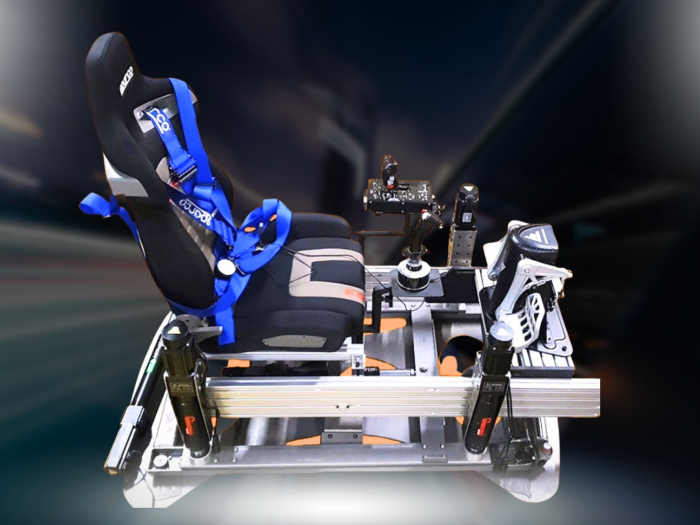

The difference between a professional-grade simulation and a high-end toy isn't found in the aesthetics; it's buried deep within the engineering tolerances of the frame. You've likely felt that unsettling flex in a mass-market rig, where a sudden weight transfer results in a groan of metal rather than a precise shift in G-force. When you invest in a home setup, motion simulator build quality becomes the single most important factor in determining whether your rig provides years of visceral immersion or becomes a noisy, vibrating liability in the corner of the room.
We understand the concern that adding motion might mean sacrificing your living space or inviting mechanical failure after a few months of heavy use. This guide will help you identify the critical engineering standards that separate industrial-strength platforms from flimsy alternatives, ensuring your investment stands up to the most aggressive driving styles. We'll explore how modern compact designs manage to maintain structural integrity whilst delivering lightning-fast telemetry, giving you the confidence to push every corner to the absolute limit without the fear of mechanical lag or structural compromise.
Key Takeaways
- Understand why eliminating structural flex is essential for ensuring your rig accurately translates digital telemetry into visceral, real-world sensations.
- Learn why industrial-grade materials and PT Actuator technology are the benchmarks for maintaining performance during high-intensity, long-duration sessions.
- Discover how a low centre of gravity allows for a full 6 DOF experience within a space-efficient footprint, solving the compact rig paradox.
- Master a professional buyer’s checklist to verify motion simulator build quality by inspecting actuator duty cycles and high-grade joint components.
- Explore how hand-built UK engineering and modular design provide a professional-grade experience that is both durable and easy to assemble at home.
The Foundation of Realism: Why Build Quality Defines Your Motion Experience
Rigid engineering is the heartbeat of a high-performance sim. It isn't merely about the thickness of the metal; it's the sophisticated synergy between hardware rigidity and the software telemetry that drives it. High-end motion simulator technology relies on this relationship to create a believable environment. If the rig lacks structural integrity, the most advanced software in the world can't save the experience. You'll find that motion simulator build quality is the primary factor that prevents a rig from feeling like a vibrating chair and turns it into a precision instrument.
Flex is the ultimate enemy of immersion. When your software commands a sharp right-hand weight transfer, any bend in the chassis absorbs that energy. Instead of feeling the car's limit, you feel the metal complaining. This mechanical lag creates a disconnect between your eyes and your inner ear, which is often the root cause of motion sickness. A professional-grade rig aligns these sensory cues perfectly, providing crisp, immediate feedback that mirrors the on-screen action. Whilst consumer-grade rigs often rely on simple vibration to mimic road feel, a professional platform uses authentic displacement to simulate actual G-forces.
The Role of Structural Rigidity in Sim Racing
Modern direct drive wheels can output immense torque, often exceeding 20Nm. A compromise in build materials means this force twists the frame rather than resisting your input. This doesn't just ruin the feeling of the steering; it introduces unwanted noise. A well-engineered platform, such as those hand-built in the UK with industrial-grade aluminium, ensures that every Newton-metre of force is directed toward the driver. This rigidity also prevents the long-term degradation of joints, keeping the rig silent even after hundreds of hours of heavy use. If the foundation is weak, the feedback is muffled.
Telemetry Translation: From Data to G-Force
Engineering the Edge: Materials and Actuators in Professional-Grade Rigs
The structural integrity of a 6 DOF platform depends on the choice of industrial-grade aluminium and steel. Unlike DIY wooden frames or budget thin-walled metal, these materials offer the rigidity needed to meet high simulator fidelity standards. In a high-performance environment, the frame must act as a static anchor for the immense forces generated by the actuators. If the frame flexes, the fidelity of the motion is lost. This is why professional motion simulator build quality relies on precision-machined components that eliminate mechanical slop.
At the heart of any specialist rig, you'll find PT Actuator technology. These linear actuators are favoured because they utilise zero-backlash components. Backlash is the tiny amount of play between gears or moving parts. In a simulation, even a millimetre of play can ruin the sensation of road texture. High-end motion simulator build quality is often defined by the absence of this mechanical noise. By using high-precision ball screws and sealed housings, PT Actuators ensure that every digital signal translates into immediate, crisp physical movement.
Actuator Quality: The Engine of Your Motion Rig
Linear actuators provide a significant advantage over cheaper geared motor systems. Whilst geared motors are often noisy and prone to wear, linear actuators offer a smoother, more direct path of travel. You should also consider weight capacity. A rig with high headroom doesn't just lift more; it moves with greater agility. When an actuator isn't constantly working at its limit, it can provide more nuanced feedback, such as the subtle vibrations of an engine idling. Sealed systems are also essential for home environments, as they require minimal maintenance compared to open-linkage designs.
Hand-Built in the UK vs. Mass-Market Rigs
Mass production often prioritises speed over precision. In contrast, hand-built assembly allows for much tighter tolerances. Every LowSlider 6 DOF platform is individually tested to ensure the geometry is perfect before it leaves the workshop. This bespoke approach means that every joint is inspected and every bolt is torqued to spec. You can learn more about Why Hand-Built Simulators Outperform Mass-Market Rigs to understand the long-term value of this craftsmanship. If you're looking for a platform that combines UK-engineered precision with a space-saving design, exploring a hand-built motion platform is the logical next step for any serious enthusiast.
Compact vs. Compromised: Assessing the Structural Integrity of Small-Footprint Simulators
Many enthusiasts believe that a smaller footprint necessitates a sacrifice in performance. This is the "Compact Rig Paradox". In reality, achieving 6 DOF stability in a confined area requires superior motion simulator build quality because the tolerances for error are much smaller. When a rig is compact, every millimetre of movement must be controlled with absolute precision. A larger rig can sometimes hide poor engineering through sheer mass, but a small-footprint platform has nowhere to hide. If the geometry isn't perfect, the physics will fail under load.
Height is often the enemy of stability in a home environment. A tall rig creates a massive lever effect, magnifying the forces applied to the base and increasing the likelihood of frame fatigue. The LowSlider design counters this by maintaining an ultra-low centre of gravity. It's a persistent myth that smaller rigs are inherently less powerful than their larger counterparts. By keeping the mass closer to the floor, the energy from the actuators is directed into the driver's seat rather than being wasted on chassis flex or floor vibration. This ensures that the feedback remains crisp and the structural integrity remains uncompromised.
The LowSlider Advantage: Engineering for the Home
A compact design does more than just save floor space; it fundamentally changes the mechanical stress profile of the rig. By reducing the distance between the motion actuators and the floor, you minimise the leverage exerted on the frame. This reduction in the "lever effect" is crucial for long-term durability. It's also a matter of practical UK engineering. We've designed the LowSlider 6 DOF to fit through standard doorways, ensuring that professional-grade hardware is accessible for home setups without requiring a dedicated warehouse or commercial space.
Stability at High G-Forces
Managing twin traction loss, the sensation of the rear end stepping out, usually requires a sprawling physical footprint. However, clever engineering allows for this lateral movement without the excessive bulk. High-quality motion simulator build quality is evident in how a rig manages these high-torque moments. By utilising precision floor mounting and integrated vibration dampening, a compact setup can remain perfectly planted even during aggressive weight transfers. This level of stability is essential for maintaining the illusion of flight or racing. For a deeper look at how we achieve this balance, read the LowSlider 6 DOF: The Ultimate Motion Platform Guide to see the engineering in action.
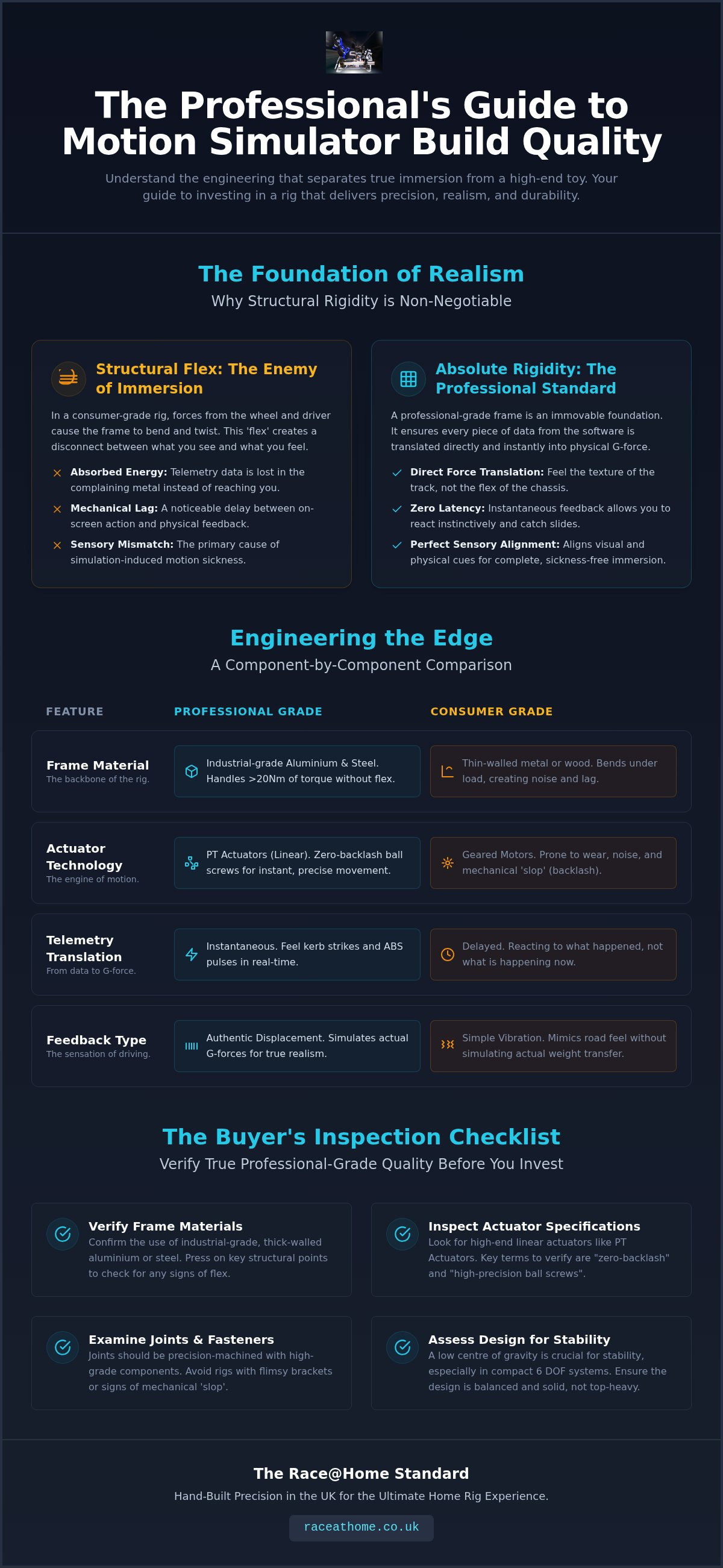
The Buyer’s Inspection Checklist: What to Look for Before You Invest
Investing in a motion platform is a significant commitment that requires more than a glance at a spec sheet. To ensure your rig provides years of visceral immersion rather than becoming a vibrating liability, you must apply a rigorous technical lens to its construction. Assessing motion simulator build quality isn't about looking for the thickest steel; it's about identifying the precision components that maintain their integrity under immense G-forces. Use the following five steps to verify the engineering pedigree of any platform before you commit your capital.
- Step 1: Verify the actuator brand. Industrial-grade components like PT Actuators are the gold standard. Check the duty cycle and speed specifications to ensure they can handle sustained, high-frequency telemetry without overheating.
- Step 2: Inspect the joint quality. Look for rose joints or high-grade bearings at every pivot point. If a manufacturer uses plastic bushings or simple bolt-through-metal designs, expect mechanical slop and noise within weeks of use.
- Step 3: Assess the modularity. A well-built rig should be an evolving investment. Check if the platform is easy to upgrade or repair, allowing you to add features like traction loss without replacing the entire chassis.
- Step 4: Evaluate the shipping method. A rig that arrives in 1,000 pieces relies on your DIY skills for alignment. Platforms shipped in pre-assembled sections maintain factory-level precision that is nearly impossible to replicate in a home garage.
- Step 5: Check for VR-readiness. Ensure the software compatibility includes high-end VR headsets like Pimax, as motion rigs require specific telemetry smoothing to prevent "VR sickness."
Evaluating Mechanical Noise and Vibration
A quiet rig is a hallmark of superior engineering. Whilst you should expect a high-pitched "whine" from high-performance electric actuators, you should never hear "clunking" or "rattling" during a weight transfer. Clunking sounds signal poor tolerances or frame flex, which will eventually lead to mechanical failure. In a home environment, a noisy rig isn't just an annoyance; it breaks the illusion of reality and disrupts the household. High motion simulator build quality ensures that the only thing you hear is the digital engine note, not the mechanical struggle of the hardware.
Assembly and Logistics: Quality in the Box
Many manufacturers use flat-pack shipping to reduce their own overheads, but this places the burden of critical alignment on the user. We believe factory-level precision is non-negotiable for professional performance. Shipping in four pre-assembled pieces guarantees that the geometry remains exactly as the engineers intended, regardless of your tool kit. For a deeper dive into the logistics of your build, see The Ultimate Sim Racing Setup Guide. If you're ready to secure a platform that prioritises UK-engineered precision over mass-market convenience, explore our range of hand-built motion platforms to find your perfect match.
The Race@Home Standard: Hand-Built Precision for the Ultimate Home Rig
The LowSlider 6 DOF represents the pinnacle of this approach. It combines professional-grade, six-degree-of-freedom movement with a compact rig footprint that fits seamlessly into a home environment. We've proven that you don't need a commercial warehouse to experience industrial-strength simulation. By focusing on a low centre of gravity and high-torque PT Actuators, we've created a platform that delivers violent weight transfers and subtle road textures with equal precision. This is engineering without the fluff, built for drivers who demand the absolute best from their hardware.
Bespoke Quality for Every Driver
Every LowSlider platform is hand-built to order in our UK workshop, allowing us to maintain the tightest possible tolerances. This isn't just about assembly; it's about a curated ecosystem. We integrate cutting-edge hardware like Pimax VR headsets and professional sim racing accessories to ensure your sensory feedback is seamless. If you are looking to elevate your setup, you can learn more about our process in our guide on how to Buy Motion Simulator UK. This bespoke focus ensures that every component, from the actuators to the aluminium frame, works in perfect harmony.
Ready to Race in Under an Hour
Clever engineering shouldn't lead to a complex setup. We've developed a proprietary four-piece assembly system that allows you to be race-ready in under an hour. Whilst other rigs arrive as a daunting collection of bolts and brackets, the LowSlider 6 DOF arrives in pre-assembled sections. This doesn't just simplify logistics; it protects the motion simulator build quality by ensuring critical alignments are handled by our specialists before the rig ever reaches your door. You get the peace of mind that comes with professional engineering without the headache of a weekend-long build. It's the ultimate evolution of the home sim rig, providing industrial-strength performance in a compact, accessible package. Explore our LowSlider motion platforms today and feel the difference that hand-built precision makes.
Elevate Your Experience with Professional-Grade Engineering
Selecting the right platform is about more than just axis count or price points; it's about ensuring that every millimetre of movement is a precise translation of digital telemetry. We've explored how superior motion simulator build quality relies on industrial-grade materials and zero-backlash actuators to eliminate the flex that ruins immersion. By prioritising structural integrity and a low centre of gravity, you can enjoy a full 6 DOF experience without the need for a commercial-sized space.
Race@Home is dedicated to providing this professional standard for the home enthusiast. Our rigs are hand-built in the UK to professional standards, utilising premium PT Actuators to deliver lightning-fast feedback. Because we ship in four pre-assembled sections, you can achieve factory-level precision with a simple one-hour assembly. Don't settle for mass-market compromises when you can invest in a platform designed for the ultimate pursuit of realism.
View the Hand-Built LowSlider 6 DOF Platform and take the first step toward a no-compromise simulation journey. We're here to help you cross the finish line with confidence.
Frequently Asked Questions
How long should a high-quality motion simulator last?
A professionally engineered rig should provide a decade or more of reliable service with minimal intervention. High-end linear actuators are rated for thousands of hours of operation under heavy load. The longevity of your setup depends on the materials used; industrial-grade aluminium and steel components ensure the frame won't fatigue or warp after years of aggressive weight transfers and high-torque feedback.
Is a compact motion racing rig as stable as a full-size platform?
Stability is a result of clever geometry rather than sheer physical mass. A compact rig with an ultra-low centre of gravity, such as the LowSlider, is often more stable than a taller, full-sized platform. By keeping the mass closer to the floor, the design reduces the lever effect on the frame, ensuring the rig remains perfectly planted even during intense traction-loss scenarios.
Does the build quality of a motion rig affect motion sickness?
Absolutely, as poor motion simulator build quality introduces mechanical lag and "slop" into the experience. When the physical movement fails to align perfectly with your visual cues, the brain experiences a sensory disconnect that leads to nausea. A rigid rig with zero-backlash actuators ensures that every digital signal translates into immediate physical feedback, effectively eliminating the primary cause of simulator sickness.
What are the signs of poor build quality in a used motion simulator?
Listen for audible "clunking" or "rattling" during sudden movements, which indicates worn joints or loose tolerances. You should also check for visible flex in the frame when the actuators are under load. If the rig utilizes budget geared motors instead of sealed linear actuators, check for "shuddering" at low speeds, as this often signals that the internal gear sets are nearing the end of their life.
Are PT Actuators better than other motion systems for sim racing?
PT Actuators are considered the gold standard for specialists because they offer superior speed and zero-backlash precision. Unlike geared motor systems that can feel "notchy" or sluggish, these linear actuators provide a smooth, immediate response. Their sealed design and industrial duty cycles make them the preferred choice for drivers who demand the highest level of detail, from engine vibrations to subtle kerb strikes.
How much maintenance does a professional-grade motion rig require?
A professional rig requires remarkably little maintenance because it uses sealed, industrial-grade components. You won't need to lubricate the actuators or recalibrate the sensors frequently. A simple monthly check to ensure all frame bolts remain torqued to specification and keeping the electronics free from dust is usually all that's required to maintain factory-level performance for years of heavy use.
Can I assemble a 6 DOF motion platform by myself?
Assembly is straightforward if the platform is designed with the home user in mind. Whilst many rigs arrive as a daunting collection of a thousand parts, our platforms ship in four pre-assembled sections. This modular approach allows a single person to complete the setup in under an hour. It ensures that the critical mechanical alignment is handled by experts before the rig ever reaches your door.
Why is aluminium profile often used for high-end sim rigs?
Aluminium profile is the material of choice because it offers an exceptional strength-to-weight ratio and total modularity. It provides the necessary rigidity to handle high-torque direct drive wheels without the unwanted flex found in thinner steel frames. This material is essential for maintaining consistent motion simulator build quality, allowing you to mount accessories and actuators with millimetre-perfect precision whilst keeping the overall rig weight manageable.


