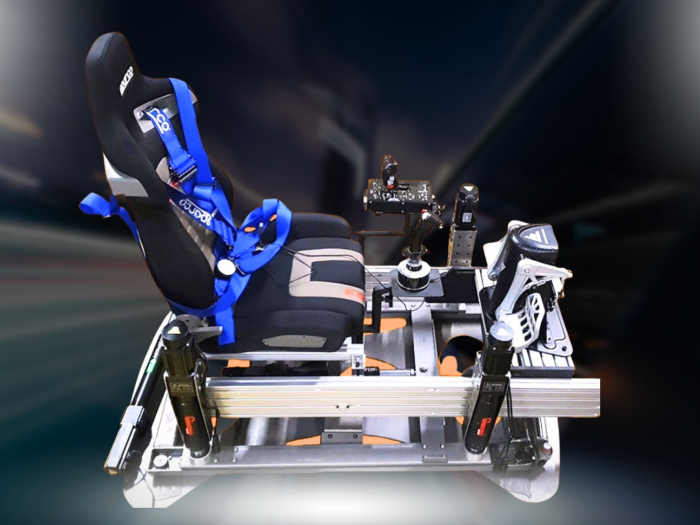

What if the reason you're losing tenths in the final sector isn't your racing line, but the fact that your brain is forced to guess what the rear tyres are doing? For the serious competitor, the transition from a static rig to a dynamic environment is the ultimate evolution in performance. Upgrading to a 6 DOF motion platform is no longer just about adding vibration to your seat; it's about translating raw telemetry into the precise, visceral feedback needed to catch a slide before it ends your session.
You likely already know that a lack of rear-end grip feedback is the biggest barrier to consistent lap times and professional-level car control. This guide promises to demystify the process of moving to a professional-grade system, covering everything from technical requirements to the sensory benefits of discrete movement profiles. We will explore how to minimise your rig's footprint using the LowSlider advantage, ensuring you feel every nuance of the car's behaviour without the latency that causes motion sickness. From modular assembly to software configuration, we are providing the roadmap to achieving a world-class training environment at home.
Key Takeaways
- Understand how discrete telemetry axes like Surge, Sway, and Yaw eliminate the "realism ceiling" of static rigs to provide professional-grade feedback.
- Learn why upgrading to a 6 DOF motion platform is essential for predicting oversteer through dedicated traction loss telemetry rather than sensory guesswork.
- Identify the critical performance gaps between 3DOF and 6 DOF systems, specifically how the absence of lateral sway and longitudinal surge limits your car control.
- Follow a practical guide to preparing your space, from measuring ceiling clearance to assessing floor load-bearing capacity for high-performance motion actuators.
- Discover how the LowSlider Twin-Traction-Loss system provides unrivalled feedback for understeer and oversteer within a compact, UK-engineered footprint.
What is a 6 DOF Motion Platform and Why Upgrade?
For the dedicated sim racer, there comes a moment where visual and auditory cues simply aren't enough to shave off those final tenths. You've reached the "realism ceiling." This is the point where a static rig or a basic 3DOF system fails to communicate the complex physics of a car at the limit. When you reach this plateau, upgrading to a 6 DOF motion platform becomes the only logical step to bridge the gap between digital simulation and physical reality. It's a fundamental shift in how you process information. You stop playing a game and start operating a high-performance vehicle.
A 6 DOF system doesn't just move; it communicates. By translating raw telemetry data into visceral physical sensations, it removes the sensory guesswork that leads to mistakes. Instead of reacting to what you see on screen, you react to what your body feels. This creates a more intuitive driving style, allowing you to catch slides earlier and find the limit of grip with far greater confidence.
The Anatomy of 6 DOF Movement
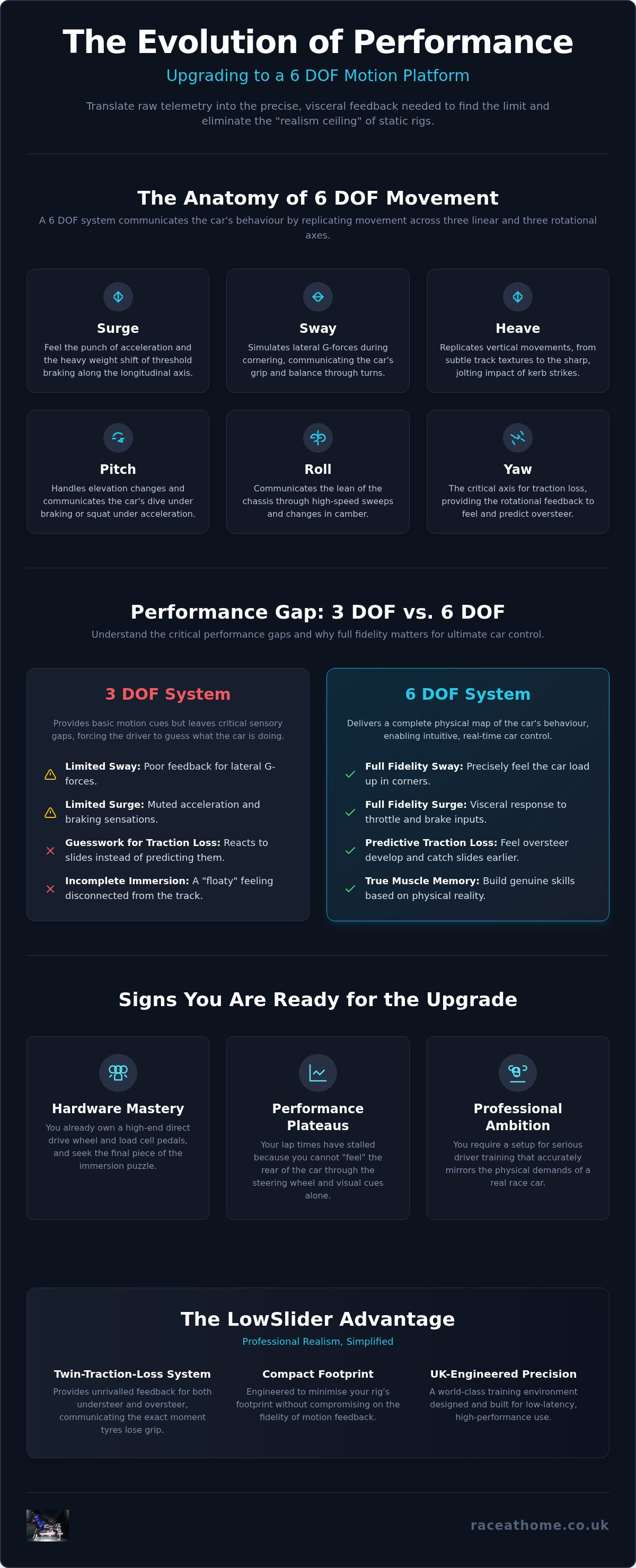
To understand the value of this upgrade, you must understand the physics it replicates. What is a 6 DOF Motion Platform? It is a system that provides movement across three linear axes and three rotational axes. Vertical movements, known as Heave, replicate track texture and the sharp jolt of kerb strikes. Lateral forces, or Sway, simulate the G-forces felt during cornering, while longitudinal Surge provides the punch of acceleration and the heavy weight shift of threshold braking.
The rotational axes add another layer of sophistication. Pitch handles elevation changes and the car's dive under braking. Roll communicates the lean of the chassis through high-speed sweeps. Most critically, Yaw provides the rotation needed to feel traction loss. When these six degrees of freedom work in harmony, the rig creates a seamless physical map of the car's behaviour, allowing your vestibular system to process the car's balance in real-time.
Signs You Are Ready for the Upgrade
How do you know it's time to make the switch? Upgrading to a 6 DOF motion platform is a significant investment in your craft, and it's typically the next step once you have refined your peripheral hardware. You are likely ready if:
- Hardware Mastery: You have already invested in high-end direct drive wheelbases and load cell pedals; you are now looking for the final piece of the immersion puzzle.
- Performance Plateaus: Your lap times have stalled because you can't "feel" the rear of the car through the steering wheel alone.
- Professional Ambition: You use your rig for serious driver training or coaching and require a setup that accurately mirrors the physical demands of a real race car.
The Sensory Benefits of Full Motion Realism
Static rigs often leave drivers feeling "floaty," as if the car is disconnected from the track surface. This sensory gap occurs because your brain is forced to rely solely on visual cues, creating a delay in your reaction time. When upgrading to a 6 DOF motion platform, this disconnect vanishes. Discrete axes of movement provide a high-frequency, low-latency response that mirrors real-world physics. By replicating specific G-force vectors, the system allows you to build genuine muscle memory, ensuring your inputs are based on physical reality rather than visual estimation.
Reliable motion isn't just about immersion; it's about performance. Research into military-grade simulation research confirms that high-fidelity motion is critical for operator performance, as it reduces the cognitive load required to interpret vehicle state. In sim racing, this translates to reduced fatigue and greater consistency over long stints. Because the platform responds to telemetry data in real-time, it eliminates the vestibular mismatch that often causes motion sickness, making your sessions more productive and comfortable.
Mastering the Limit: The Importance of Traction Loss
The most significant advantage of a professional 6 DOF setup is the ability to predict oversteer. Whilst many basic rigs offer a single axis of yaw, this is often insufficient for high-speed cornering where the car's balance is constantly shifting. The mechanical advantage of Twin Traction Loss lies in its ability to communicate the exact moment the rear tyres lose their grip on the tarmac.
This dedicated feedback loop allows you to "save" the car before the visual cue even reaches your eyes. You feel the chassis rotate and the rear end step out through your hips, prompting an instinctive counter-steer. This level of communication is what separates a gaming setup from a professional training tool. If you're looking to refine these instincts, the LowSlider 6 DOF provides the precision needed to master the limit of any GT or formula car.
VR Integration and 6 DOF Synergy
For those using virtual reality, the synergy between motion and vision is transformative. Upgrading to a 6 DOF motion platform is the perfect partner for Pimax VR headsets, as it achieves 1:1 sensory mapping. When your eyes see a elevation change or a heavy braking zone, your body feels the corresponding pitch and surge instantly.
This "closed-loop" environment is essential for total immersion. Without 6 DOF motion, the brain detects a conflict between the inner ear and the eyes, which is the primary cause of VR-induced nausea. By aligning these physical and digital signals, you can race for hours without discomfort, fully absorbed in a world where every kerb strike and gear change feels exactly as it should.
6 DOF vs 3DOF: Identifying the Real-World Difference
The transition from 3DOF to 6 DOF isn't just an incremental improvement; it's a complete architectural shift in how motion is delivered to the driver. Whilst a 3DOF system provides a taste of the action, it often forces a compromise between heave and traction loss. In these entry-level configurations, the actuators must share duties, frequently resulting in "muddy" feedback where track textures and rear-end rotation blend into a single, less distinct sensation. Upgrading to a 6 DOF motion platform removes these limitations by providing dedicated hardware for every physical vector.
The real-world difference lies in the "Missing Links" of sway and surge. Without these, you lose the lateral G-forces that tell you how much load is on the outside tyres and the longitudinal forces that communicate the intensity of your braking. For the serious racer, these aren't just immersive details; they are critical data points. Choosing 6 DOF is an investment in longevity. It represents the "end-game" for sim racing hardware, ensuring your rig remains relevant as your skills and professional ambitions evolve.
Technical Breakdown: Actuator Count and Movement
Feedback clarity is a direct result of actuator isolation. In a 3DOF setup, the system might use three or four actuators to simulate pitch, roll, and heave, often leaving traction loss to a separate, bolted-on slide. This creates a mechanical disconnect. 6 DOF platforms use at least six actuators to isolate every possible vehicle movement. This configuration allows for the implementation of advanced control algorithms for 6 DOF platforms, which ensure that a kerb strike (heave) never interferes with your perception of a slide (yaw).
By using independent actuators for every axis, the system can replicate complex, overlapping forces simultaneously. You can feel the car "set" into a corner through sway, while roll communicates the suspension compression and heave delivers the vibration of the rumble strip. This level of technical sophistication is what transforms a simulator into a high-fidelity engineering tool.
Choosing the Right Path for Your Career
Preparing Your Space for a 6 DOF Upgrade
Success in upgrading to a 6 DOF motion platform depends as much on your environment as it does on the hardware itself. Unlike static rigs, a professional motion system is a dynamic piece of engineering that requires specific physical and technical conditions to operate at peak performance. Before your platform arrives, you must audit your space to ensure it can handle the physical forces and data requirements of a high-fidelity simulator.
- Step 1: Measure Dimensions. You need more than just floor space. 6 DOF rigs move vertically and rotationally, so ensure you have at least 50cm of clearance around the entire perimeter and sufficient ceiling height for maximum heave extension.
- Step 2: Floor Capacity. High-torque actuators generate significant downward force during rapid heave and pitch movements. Ensure your floor is level and capable of supporting the combined weight of the rig, the driver, and the dynamic loads.
- Step 3: Power Supply. A 6 DOF system typically requires dedicated power circuits. Using high-quality surge protection and ensuring your household circuit can handle the peak draw of six actuators is vital for hardware longevity.
- Step 4: PC Specifications. Telemetry processing is CPU-intensive. High CPU clock speeds are more important than core count for maintaining the low-latency signal required to keep the motion in sync with the simulation.
- Step 5: Cable Management. Because the entire rig moves, cables must be secured with enough slack to prevent tension during full-range motion. Use industrial-grade cable "snakes" or trunking to protect your connections.
The Compact Philosophy: Overcoming Space Constraints
Traditional 6 DOF rigs often resemble industrial machinery, requiring dedicated garage spaces or large outbuildings. This footprint has historically been a barrier for home users. However, the development of the low-profile motion rig has changed the logistics of upgrading to a 6 DOF motion platform. By utilising a modular, low-slung design, the LowSlider system fits professional-grade movement into a standard room footprint. If you are restricted by space but refuse to compromise on degrees of freedom, you can view the LowSlider 6 DOF technical specifications to see how it integrates into a home environment.
Technical Compatibility and Mounting
Rigidity is the foundation of motion accuracy. Any flex in your seat or pedal plate will absorb the subtle telemetry cues the actuators are trying to provide. When selecting sim racing accessories, prioritise heavy-duty aluminium profiles and reinforced mounting brackets. To manage the physical vibrations and protect your floor, use high-density rubber isolation matting. This doesn't just reduce noise; it also sharpens the feedback by ensuring the energy is directed into the driver rather than dissipated into the ground.
The LowSlider 6 DOF: Professional Realism, Simplified
The culmination of your journey in upgrading to a 6 DOF motion platform is the selection of the hardware that will define your racing career. Race@Home represents the pinnacle of this evolution with the LowSlider 6 DOF Twin-Traction-Loss Motion Platform. Every unit is hand-built in the UK, reflecting a commitment to engineering excellence that off-the-shelf mass-produced solutions cannot match. Whilst other systems focus on generic movement, the LowSlider prioritises the accurate translation of digital data into tangible, high-fidelity sensations.
The defining feature of this system is the Twin-Traction-Loss advantage. As we have explored, feeling the rear end of the car is vital for consistent performance. Our proprietary system provides unrivalled feedback for both oversteer and understeer, allowing you to sense the car's behaviour with surgical precision. This is not just about movement; it's about the discrete communication of physics that helps you find the limit and stay there. By isolating these specific forces, we remove the sensory guesswork from your driving.
We understand that the logistics of a full-motion rig can be a significant barrier. To solve this, we ship the platform worldwide in four modular pieces. This design allows for a one-hour setup time, moving you from delivery to the track in record time. You won't need a team of engineers or a week of troubleshooting to get started. The process is streamlined to ensure you spend your time racing, not configuring complex mechanical assemblies.
Proprietary LowSlider Engineering
The heart of the system lies in its ultra-low centre of gravity. This design choice improves stability and sharpens the platform's response to high-frequency telemetry signals. We utilise high-performance PT Actuators, which are the industry standard for precision and reliability in professional simulation. Because each platform is hand-built to order, we can offer customisable components tailored to your specific requirements, ensuring the hardware perfectly complements your existing cockpit and driving style.
Next Steps: Joining the Full Motion Elite
Taking the leap into professional-grade simulation is a transformative experience for any serious competitor. When you are ready to begin upgrading to a 6 DOF motion platform, our team is here to provide the technical support and guidance you need for a seamless transition. We offer worldwide shipping to ensure that the highest level of sim racing realism is accessible to drivers regardless of their location. You can explore the LowSlider 6 DOF Motion Platform and start your upgrade today.
Elevate Your Performance with Professional-Grade Motion
The transition from a static rig to a dynamic environment represents a fundamental shift in how you process the physics of racing. By providing independent axes for sway, surge, and traction loss, you stop reacting to what you see and start anticipating how the chassis will behave. Upgrading to a 6 DOF motion platform is the definitive step toward mastering the limit of car control and achieving professional-level consistency at home.
With the LowSlider system, you're investing in hand-built British engineering that prioritises a compact footprint without sacrificing a single degree of freedom. Our modular design ships worldwide in four pieces, allowing for a straightforward one-hour self-assembly process that gets you back on track immediately. It's time to remove the sensory guesswork and experience the visceral reality of the circuit with a rig that matches your ambition.
Upgrade to the LowSlider 6 DOF Twin-Traction-Loss Platform and redefine your competitive edge. Your fastest lap is waiting; we're here to help you feel it.
Frequently Asked Questions
Do I need a special PC to run a 6 DOF motion platform?
You don't necessarily need a bespoke PC, but a high-performance system with a strong emphasis on CPU clock speed is essential. Telemetry processing for six independent actuators is computationally intensive; a faster processor ensures that the motion remains perfectly synchronised with the simulation. Whilst a modern GPU handles the visuals, the CPU performs the heavy lifting of translating digital data into physical movement without introducing latency.
How much space does a 6 DOF motion simulator actually require?
Space requirements vary by design, but a standard 6 DOF rig typically needs a footprint of approximately 2 metres by 1.5 metres. You must also account for a 50cm safety clearance around the perimeter to accommodate the platform's full range of motion. The LowSlider design is specifically engineered to be low-profile, allowing it to fit into standard room footprints that would be too small for traditional systems.
Can a 6 DOF platform help reduce sim racing motion sickness?
A high-fidelity 6 DOF platform can significantly reduce motion sickness by eliminating the vestibular mismatch that occurs when your eyes see movement your body doesn't feel. By providing 1:1 sensory mapping, the rig ensures your inner ear and eyes receive consistent signals. This is particularly effective when upgrading to a 6 DOF motion platform for VR, where sensory alignment is critical for comfort.
What is the difference between single and twin traction loss?
Single traction loss typically provides a basic yaw rotation, whilst Twin Traction Loss offers a sophisticated dual-pivot system that replicates the complex movement of a car's rear end. This allows you to feel the subtle difference between a slight slide and a total loss of grip. It provides clearer communication of oversteer and understeer, giving you the tactile data needed to make precise corrections mid-corner.
Is the LowSlider 6 DOF compatible with my existing sim racing seat?
The LowSlider 6 DOF platform is designed for broad compatibility with standard sim racing seats and aluminium profile cockpits. Because it uses a modular mounting system, you can typically integrate your existing seat, provided it is rigid enough to handle the dynamic forces. We recommend using high-quality, side-mounted bucket seats to ensure that every nuance of the motion is transferred directly to your body without being absorbed.
How long does it take to assemble a Race@Home 6 DOF platform?
You can typically complete the assembly of a Race@Home platform in under an hour. We ship the system worldwide in four pre-assembled modular pieces, which significantly simplifies the installation process. You won't need specialised engineering tools or advanced technical knowledge; the provided instructions guide you through connecting the modules and calibrating the software so you can get on the track as quickly as possible.
Does a motion platform make you faster in sim racing?
Whilst a motion platform doesn't automatically increase your raw speed, it makes you more consistent by providing the physical cues needed for better car control. Upgrading to a 6 DOF motion platform allows you to feel the limit of grip, enabling you to catch slides and manage weight transfer intuitively. This increased confidence often results in more stable lap times and better performance during long race stints.
What maintenance is required for a high-end motion rig?
High-end motion rigs are engineered for durability and require very little maintenance. You should periodically check that all mounting bolts remain tight and ensure that your cables still have enough slack to move freely without tension. The PT Actuators used in our systems are industrial-grade and designed for longevity. Keeping the rig clean and free of dust will ensure the mechanical joints remain reliable and perform at their peak.


