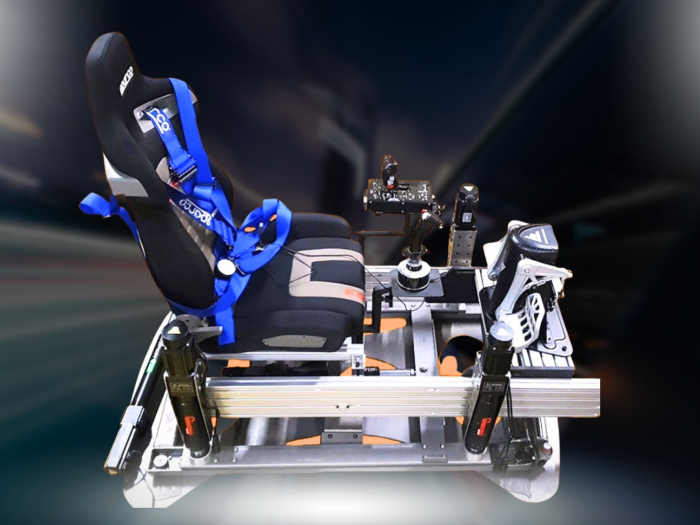

The biggest mistake in high-end sim racing isn't choosing the wrong wheelbase; it's investing in a motion platform that moves your body without accurately telling your brain what the tyres are doing. You've likely spent hours weighing up the costs, perhaps fearing that a more complex rig will be too bulky for your home or simply overkill for your current pace. It's a valid concern, especially when the technical terminology feels designed to confuse rather than clarify.
We understand that every millimetre of movement must serve a purpose. This 2026 comparison guide explores the technical and sensory nuances of the 3DOF vs 6DOF motion simulator to help you determine which system best suits your competitive ambitions. Whether you're looking for the essential feedback of pitch and roll or the complete immersion of a full-degree-of-freedom setup, you'll find the clarity needed to invest with total confidence.
We'll break down the physics of the LowSlider range, examine why Twin-Traction-Loss is a game-changer for car control, and explain how our compact engineering solves the traditional problem of rig footprint. By the end, you'll know exactly which platform will bridge the gap between digital telemetry and real-world sensation.
Key Takeaways
- Learn how each degree of freedom translates into visceral sensations, bridging the gap between digital telemetry and physical feedback.
- Understand why a 3DOF system provides the essential foundation for weight transfer whilst maintaining a simpler mechanical profile.
- Discover why the 3DOF vs 6DOF motion simulator debate often comes down to the critical inclusion of surge and sway for professional realism.
- Explore how the hand-built LowSlider engineering allows you to fit a high-performance 6DOF platform into a standard home environment.
- Gain the technical clarity required to match your specific racing discipline to the right hardware, ensuring your investment delivers maximum immersion.
Understanding Degrees of Freedom: The Physics of Sim Racing Immersion
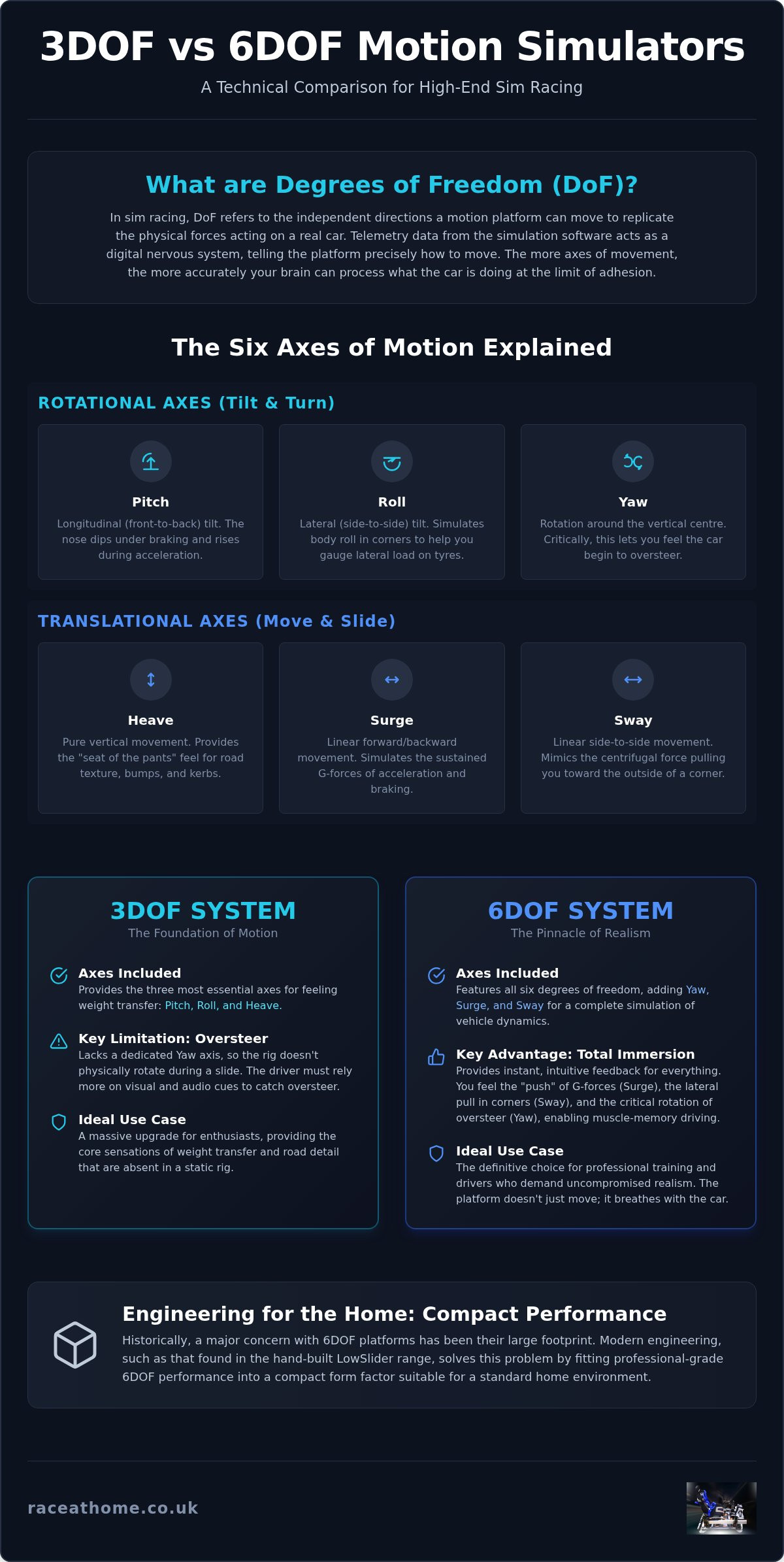
To master the track, you need more than just a visual reference. You need to feel the car's weight shifting beneath you. This is where Degrees of Freedom (DoF) come into play. In the context of a 3DOF vs 6DOF motion simulator, DoF refers to the independent directions in which a platform can move. A standard static rig offers zero DoF, whilst a professional-grade setup uses precision actuators to replicate the physical forces acting upon a real chassis. The more axes you have, the more accurately your brain can process what the car is doing at the limit of adhesion.
Sim racing software acts as the digital nervous system of your rig. It captures thousands of telemetry data points per second, telling the hardware exactly how the vehicle is behaving on the asphalt. If you're driving a GT3 car through the compression at Eau Rouge, the software calculates the vertical load and the lateral pull. A 6DOF system can replicate every single vector of that movement simultaneously. In contrast, a 3DOF system must use "washout" filters to prioritise specific sensations, often sacrificing one force to make room for another.
The Three Rotational Axes
- Pitch: This simulates longitudinal tilt. When you slam on the brakes, the nose of the rig dips; when you accelerate, it rises. It's essential for feeling weight transfer during heavy deceleration.
- Roll: This replicates side-to-side tilt. As you turn into a high-speed corner, the rig leans to simulate the car’s body roll, helping you gauge the lateral load on your outside tyres.
- Yaw: This is the rotation around the vertical centre. It's the most critical axis for detecting oversteer. If the back end of the car steps out, yaw movement lets you feel the slide before your eyes even register it on screen.
The Three Translational Axes
- Heave: This is pure vertical movement. It captures road texture, bumps, and the harsh vibration of rumble strips, providing the "seat of the pants" feel required for consistency.
- Surge: This represents the linear "push" of acceleration and the "pull" of braking. Unlike pitch, which just tilts you, surge moves the entire platform to simulate sustained G-forces.
- Sway: This provides lateral linear movement. It mimics the centrifugal force that pulls a driver toward the outside of a bend, adding a layer of physical strain that makes long endurance stints feel genuinely demanding.
The true magic happens when these axes work in harmony. When all six are present, the simulator doesn't just move; it breathes with the car. This total immersion is what allows a driver to stop "playing a game" and start "driving a vehicle," using muscle memory rather than just visual cues to find those final tenths of a second.
The 3DOF Experience: Pitch, Roll, and Heave Explained
For many enthusiasts, 3DOF represents the definitive entry point into full-motion sim racing. Whilst 2DOF systems merely tilt the seat, a 3DOF platform moves the entire chassis, including your pedals and wheel. This creates a cohesive environment where your body and controls remain in the same relative position. It's a massive leap in immersion that transforms the way you interact with the digital track. You're no longer just watching a car move; you're part of the machine.
The primary feedback in this configuration comes from Pitch and Roll. These axes do the heavy lifting of simulating weight transfer. When you transition through a fast chicane, the Roll axis tilts the rig to mimic the car's body lean. Pitch handles the longitudinal shift, dipping the nose under heavy braking and lifting it during hard acceleration. However, the addition of Heave is what truly separates this from basic setups. Heave provides vertical movement, allowing you to feel the high-frequency vibrations of the track surface. You'll feel the harsh strike of a kerb at the apex and the subtle undulations of the tarmac through your entire body.
There are limitations to consider when weighing up a 3DOF vs 6DOF motion simulator. Because a 3DOF rig lacks dedicated Yaw and Sway axes, it can feel slightly disconnected during a slide. You might see the back end step out on screen, but your body won't feel that lateral "snap" or the rotation of the car. It is a physical feedback gap that requires the driver to rely more on visual and audio cues than pure vestibular sensation. For many, this is a manageable compromise, but for those seeking professional-grade training, those missing axes are vital.
Who is a 3DOF Platform For?
This configuration is often the "sweet spot" for pilots. Flight simulators rely heavily on verticality and pitch, making 3DOF more than sufficient for general aviation or commercial flight training. Just as simulator pilots require precision, real-world operators of flight hardware such as drones must ensure peak performance; for technical assistance, drones-r-us.ca provides specialist repair services. For sim racers, it's the ideal choice if you're transitioning from a static rig but need to manage a smaller footprint or a more conservative budget. It delivers the essential sensations of car behaviour without the mechanical complexity of a full six-axis setup, making it a reliable workhorse for daily practice.
The LowSlider 3DoF Approach
We don't believe entry-level should mean low-performance. By utilising high-end PT Actuators, we ensure that every movement is instantaneous and precise. The LowSlider 3DoF motion platform provides a gateway to professional motion, offering a compact solution that fits into standard rooms whilst maintaining the same industrial-grade build quality as our flagship models. It serves as an uncompromising foundation for those who prioritise speed and stability. If you're ready to move beyond static racing, exploring our range of motion platforms is the first step toward true track-side realism.
The 6DOF Advantage: Why 6 Degrees of Freedom Redefines Realism
If a 3DOF system provides the foundation of movement, a 6DOF platform represents the ultimate evolution of the hobby. Whilst many believe that three axes are sufficient for racing, the transition to six degrees of freedom eliminates the "sensory gaps" that force your brain to work overtime. In a 3DOF vs 6DOF motion simulator comparison, the primary advantage lies in the addition of translational movements: Surge, Sway, and Yaw. These aren't just technical specifications; they are the physical building blocks of a professional-grade driver training environment.
Surge and Sway are the silent heroes of high-performance simulation. Surge replicates the longitudinal forces that occur during rapid gear shifts and sustained braking. It provides that visceral "kick" in the back when you upshift a sequential gearbox under full load. Sway, on the other hand, handles the lateral g-forces experienced in high-speed bends like Copse or Blanchimont. Without Sway, your body only feels the car tilt; with it, you feel the entire chassis being pulled toward the outside of the track, precisely as it would behave in a real GT3 or Formula car.
Twin-Traction-Loss: The Sim Racer’s Secret Weapon
The most significant differentiator for any competitive racer is the integration of Yaw, specifically through a twin traction loss motion platform. This technology replicates the rotation of the vehicle around its vertical centre, allowing you to feel the rear tyres losing grip long before your eyes register the slide on screen. By the time you see the car rotating in your peripheral vision, it's often too late to save the lap. Feeling that "snap" through your hips allows for instantaneous corrections, turning a potential crash into a controlled, time-saving drift. It's the difference between reacting to the past and driving in the present.
6DOF vs 3DOF: A Direct Comparison
The choice between these systems often dictates the ceiling of your performance. A 3DOF rig is excellent for weight transfer, but it essentially provides a "theatrical" representation of racing. A 6DOF system provides full vehicle dynamics, which is essential for developing genuine muscle memory. If you use VR, the synergy of 6DOF is even more profound. The vestibular system in your inner ear expects specific movements based on what your eyes see; if those movements are missing, the immersion breaks and motion sickness can occur. A 6DOF platform ensures that every visual cue is matched by a physical sensation, creating a "no-compromise" environment where you can push the car to its absolute limit with total confidence.
Choosing the Right Motion Platform for Your Home Sim Rig
Deciding on a 3DOF vs 6DOF motion simulator isn't just about the number of actuators; it's about matching the hardware to your primary racing discipline. If your focus is GT3 or Formula racing, the lateral cues of Sway and the rotational feedback of Yaw are non-negotiable for finding the limit. For rally enthusiasts, whilst Heave is the priority for feeling road texture, the erratic nature of a car's movement on gravel makes 6DOF the superior choice for total control. If you're purely a flight simmer, a 3DOF setup may suffice, but for anyone looking to shave tenths off a lap time, the extra axes provide the data your brain needs to react instinctively.
Future-proofing is another critical factor. Many racers start with 3DOF only to realise they've outgrown the feedback within months. Investing in a 6DOF platform from the outset is often more cost-effective than attempting to upgrade or sell a mid-tier rig later. You also need to consider software ecosystem compatibility. Most professional platforms integrate seamlessly with SimTools or Sim Racing Studio (SRS), ensuring your hardware can translate telemetry from every major title, from iRacing to Assetto Corsa Competizione, without complex troubleshooting.
Space and Setup Requirements
A common misconception is that a full-motion rig requires a dedicated garage or a massive industrial space. Our LowSlider engineering challenges this by maintaining an ultra-low profile that fits into standard spare rooms or home offices. Whilst traditional 6DOF systems can be cumbersome, our 4-piece assembly design allows for a setup time of under an hour. You don't need a specialised power grid either; high-performance actuators are now efficient enough to run on standard home circuits. For more detailed hardware advice, you can consult our guide on sim rig motion platform compatibility to ensure your existing equipment is ready for the move.
Motion Sickness and Comfort
It sounds counterintuitive, but a 6DOF platform can actually reduce motion sickness. Nausea in sim racing usually stems from a vestibular mismatch, where your eyes see movement that your body doesn't feel. By aligning visual cues with physical feedback across all six axes, your brain accepts the simulation as reality. This becomes even more vital when using high-resolution headsets; a Pimax VR motion simulator setup enhances the 6DOF experience by providing the visual clarity to match the physical intensity. If you're ready to build the ultimate home cockpit, explore our range of hand-built motion platforms and start your journey toward professional-grade realism today.
LowSlider Engineering: Professional 6DOF Performance in a Compact Footprint
Engineering excellence isn't just about the number of axes; it's about how those axes are integrated into your environment. The LowSlider design philosophy centres on a stability-first approach. By keeping the centre of gravity as low as possible, we eliminate the mechanical flex and unwanted oscillations that often plague taller, mass-market rigs. This ultra-low profile ensures that every bit of energy from the precision actuators is transferred directly to the driver rather than being lost in the frame. When you're choosing between a 3DOF vs 6DOF motion simulator, the rigidity of the platform is what determines whether that feedback feels like a high-performance vehicle or a vibrating chair.
We've designed our systems specifically for the modern home user who refuses to compromise on quality. Whilst many competitors ship crates of loose bolts and complex aluminium extrusions, our 4-piece assembly promise means you can move from crate to cockpit in under an hour. This efficiency extends to our logistics. We ship our 6DOF platforms worldwide, ensuring that professional-grade hardware is accessible regardless of your location. It's a "no-headache" approach to high-end sim racing that prioritises your time on the track over time spent with a spanner.
Bespoke Manufacturing in the UK
There's a significant difference between mass-produced kits and hand-built UK craftsmanship. Each LowSlider rig is constructed with a focus on rigour and longevity, designed to withstand the violent, high-frequency forces of professional-grade actuators for years to come. This bespoke approach allows us to offer customisation options that suit both professional racing teams and dedicated home enthusiasts. If you're looking for the definitive guide on where to buy motion simulator UK systems, you'll find that our commitment to industrial-grade engineering sets us apart from the standard consumer market.
Summary: Making the Final Decision
Choosing the right platform comes down to your personal ambitions. A 3DOF system offers a fantastic entry-level realism that captures the essential weight transfer of racing. However, for those who want total immersion and the competitive edge of feeling every slide through Twin-Traction-Loss, the LowSlider 6DOF is the ultimate evolution. Its compact footprint means you don't need a dedicated warehouse to experience world-class physics in your own home. If you're still unsure which configuration will best serve your lap times, we're here to help. Reach out to our team for a professional consultation, and let's organise the perfect motion solution for your sim racing journey.
Take Control of Your Sim Racing Future
Choosing between a 3DOF vs 6DOF motion simulator is more than a technical decision; it's an investment in your development as a driver. Whilst 3DOF provides the essential sensations of weight transfer, only a 6DOF platform delivers the complete physics required for professional-grade training. By incorporating surge, sway, and traction loss, you stop reacting to the past and start anticipating the car's behaviour in real time.
Our UK-designed and hand-built platforms prove that you don't need an industrial warehouse to house a world-class cockpit. The compact LowSlider footprint allows you to experience the same high-performance feedback used by professional drivers and enthusiasts worldwide, all within the comfort of your home. It's time to bridge the gap between digital telemetry and visceral reality.
If you're ready to redefine your limits on the track, Explore the LowSlider 6 DOF Motion Platform today. Your ultimate racing experience is just an hour of assembly away.
Frequently Asked Questions
What is the main difference between 3DOF and 6DOF for sim racing?
The primary distinction lies in the number of physical forces replicated. A 3DOF platform covers rotational pitch and roll alongside vertical heave, which simulates basic weight transfer. A 6DOF system adds surge, sway, and yaw. This provides a complete replication of vehicle physics, allowing you to feel lateral g-forces and rear-end traction loss. The 3DOF vs 6DOF motion simulator choice determines if you feel just the car's tilt or its full spatial movement.
Does a 6DOF motion platform take up much more space than a 3DOF one?
Not necessarily. Whilst traditional industrial simulators were massive, our LowSlider design prioritises an ultra-low profile and a compact footprint. The LowSlider 6DOF is specifically engineered to fit into standard home offices or spare rooms without requiring structural modifications. It offers the same spatial efficiency as many mid-tier 3DOF setups whilst delivering a significantly higher level of sensory data for the driver.
Can a 6DOF motion simulator help reduce motion sickness?
Yes, a full-motion system can significantly reduce nausea. Motion sickness typically occurs when your eyes see movement that your vestibular system doesn't feel. By providing physical feedback across all six axes, the simulator aligns your body's sensations with the visual cues from your monitor or VR headset. This synchronisation helps the brain accept the simulation as reality, allowing for much longer and more comfortable racing sessions.
Is 3DOF enough for a professional driver training setup?
Whilst 3DOF is a massive improvement over a static rig, it's rarely sufficient for professional-grade training. Real-world drivers rely on sway and traction loss to feel the limit of adhesion and lateral g-forces in high-speed corners. A 6DOF system provides these nuanced data points, which are essential for building genuine muscle memory. For those using sim racing as a tool for real-track preparation, the extra axes are vital.
How difficult is it to assemble a 6DOF LowSlider platform at home?
It's designed to be remarkably straightforward. The LowSlider 6DOF features a 4-piece assembly process that typically takes under an hour to complete. We ship the platform in manageable sections with clear, concise instructions, so you don't need an engineering degree to get started. It's a professional-grade solution that prioritises a "plug and play" approach, getting you into the cockpit and onto the track with minimal technical downtime.
What sim racing games support 6DOF motion platforms?
Almost every major sim racing title supports 6DOF through telemetry data. This includes industry standards such as iRacing, Assetto Corsa Competizione, Dirt Rally 2.0, and the F1 series. These titles output high-frequency telemetry that software like SimTools or SRS translates into precise actuator movement. If a game has a competitive following or a focus on realism, it almost certainly supports full six-axis motion feedback.
Do I need special electrical wiring for a home motion simulator?
You don't need any specialised electrical work or industrial power upgrades. The high-performance actuators used in our rigs are efficient enough to run on standard UK home circuits. You simply plug the control box into a regular wall socket. We always recommend using a high-quality surge protector to safeguard your hardware, but the system is designed to be entirely compatible with a standard domestic power supply.


