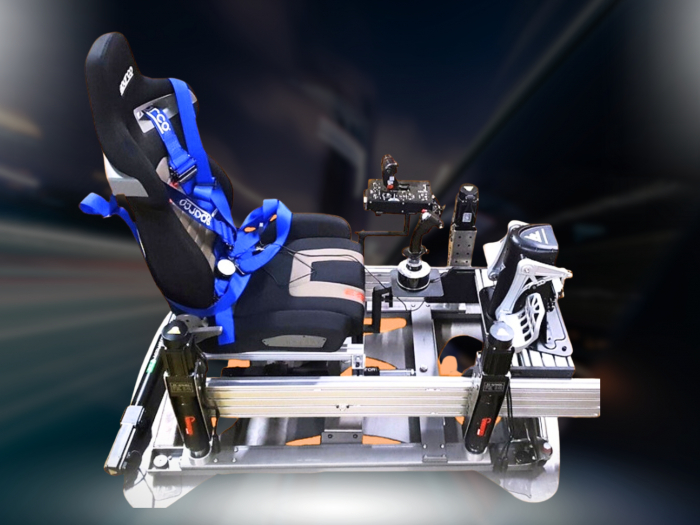

The most capable motion rig isn’t automatically the best fit. A 2DOF setup uses two actuators to create pitch and roll; 3DOF adds a third actuator for heave. The limitations of DIY motion rigs often come down to more than axis count: actuator force, usable travel, control response and the cockpit’s ability to handle dynamic loads all shape the result.
It’s easy to see why two actuators appeal: they add movement to a sim racing cockpit without a third axis. But pitch and roll cannot reproduce heave, and adding actuators brings extra demands on power, mounting and tuning. Movement feels convincing only when the system and frame can handle it.
This guide compares 2DOF and 3DOF, explains what two-actuator setups can and can’t do, and shows how load capacity and changing forces affect a DIY build. You’ll get a clearer sense of which motion cues matter to you, and where a home-built rig’s compromises may shape the experience.
Key Takeaways
- Match the motion axes to the cues you want to feel, rather than assuming more movement will always feel more realistic.
- Account for the extra engineering demands of a DIY build, including actuator control, wiring, power delivery and tuning.
- Assess load capacity against the complete moving setup, and consider how rapid direction changes affect the frame and actuators.
- Weigh the time, component and upkeep demands alongside the initial build when deciding whether DIY is the right route.
2DOF limitations compared with 3DOF
Two-axis motion conveys pitch and roll; a third axis adds heave. That difference determines which vehicle movements you feel through the seat.
Two-degree-of-freedom limitations
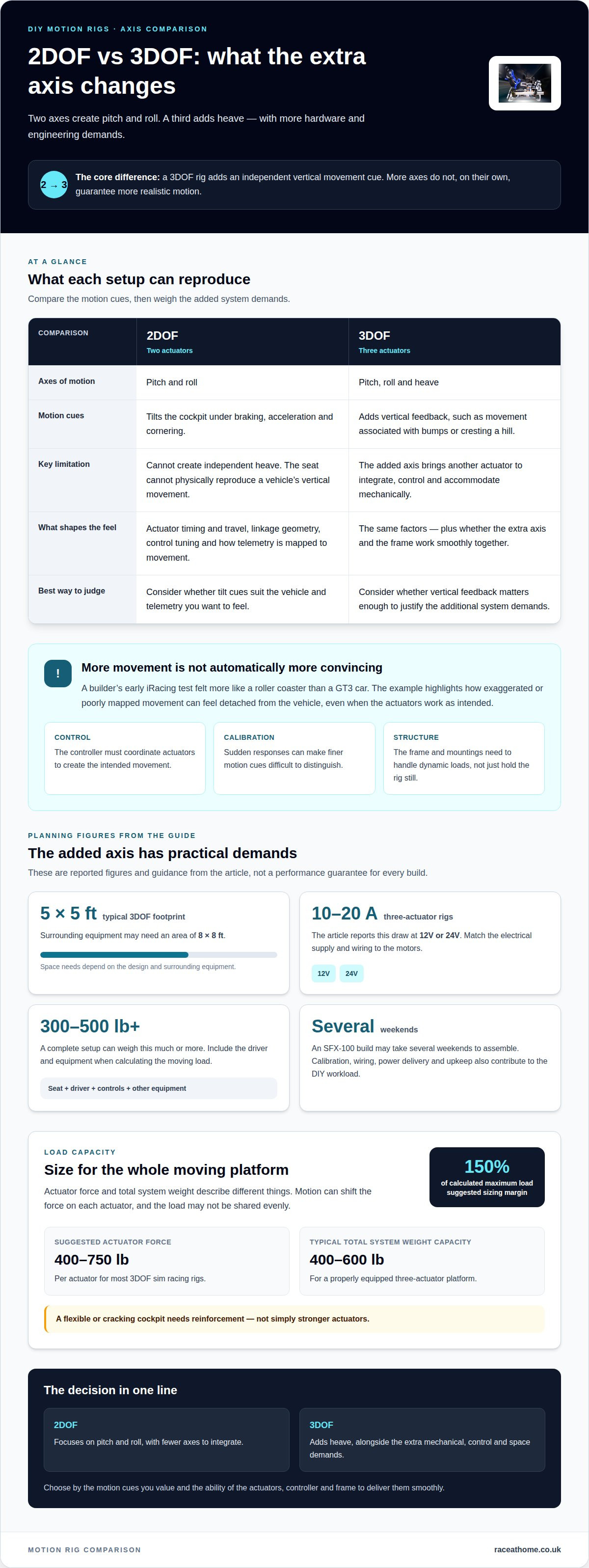
A 2DOF rig uses two actuators to create pitch and roll. It can tilt the cockpit under braking, acceleration and cornering, translating telemetry into clear movement. But it cannot create independent heave, the vertical motion associated with bumps or cresting a hill. If a track or flight model relies on that cue, the missing axis limits the physical sensation. Your monitor still shows the event, but your seat cannot reproduce its vertical movement.
Comparison with three-degree-of-freedom rigs
A 3DOF rig adds a third actuator, giving it heave alongside pitch and roll. This provides another way to reproduce vertical movement, but the extra axis also means another actuator to integrate, control and accommodate mechanically. The choice depends on the cues you value: 2DOF focuses on tilt, while 3DOF can add vertical feedback. Neither axis count alone guarantees realistic motion; the rig’s movement must suit the vehicle and telemetry.
Compared with commercial simulators, DIY rigs leave more design, assembly and tuning decisions to you. Commercial systems are designed as integrated platforms, while a DIY build depends on the components you choose and how well they work together.
Legal requirements depend on where and how you use the rig. Match the electrical supply and wiring to the motors, and remember that modifications may affect component warranties.
Assembly and calibration can be demanding: an SFX-100 build may take several weekends. Wiring interference can also disrupt SMC3 position readings when motors change direction.
Moving actuators create pinch points, while an unstable frame can shift under load. Secure the mounting, keep clear of moving parts and test the motion gradually.
Game compatibility depends on whether the rig’s motion-control software can receive simulation telemetry. Support varies by game and software, so check how the signal reaches the system.
Space, noise, power and weight depend on the design. A typical 3DOF rig uses roughly a 5-foot-by-5-foot footprint; surrounding equipment may need an 8-foot-by-8-foot area. Three-actuator rigs can draw 10-20 amps at 12V or 24V, while a complete setup can weigh 300-500 pounds or more. Motor and frame movement can also transmit noise through the floor.
Limitations of two-actuator setups
A two-actuator setup uses two powered points to move a simulator through pitch and roll. Its compact mechanism can reproduce braking and cornering cues, but the actuators must work together. If their timing or travel differs, the seat may tilt unevenly instead of responding in a controlled way. The result depends on linkage geometry, control tuning and how the simulator maps telemetry to movement.
That mapping matters as much as the hardware. During an early iRacing test, one builder said the motion felt more like a roller coaster than a GT3 car. This illustrates a key limitation: strong or frequent movement is not automatically convincing. If steering, braking and track data produce exaggerated tilts, the simulator can feel detached from the vehicle, even when both actuators are moving as intended.
DIY control can add another layer of difficulty. In one reported build, motors did not move until PWM reached 50-60, then moved quickly with substantial inertia. The builder set proportional gain to 110, but higher gains made the motor surge and stop while following a waveform. These details show why smooth output takes calibration: a sudden response at the start of movement can make fine cues difficult to distinguish.
Two actuators also leave less room to separate competing cues. A controller must coordinate both units to create the intended tilt, so an abrupt change in direction can affect the whole platform. Before building, define the sensations you want, then consider whether a simpler motion profile suits your driving style. If a more integrated platform better matches your goals, explore motion simulation options as another route.
A 3DOF sim racing motion rig adds a third actuator to control heave as well as pitch and roll, offering another configuration to consider when evaluating motion needs.
Load capacity and dynamic forces
Load capacity is the weight a motion system can move while operating. A typical complete sim rig can weigh 300-500 pounds or more, including the driver and equipment.
Load capacity
Calculate the moving load from the entire platform, seat, driver, controls and other equipment. DIY actuator sizing should allow for at least 150% of the calculated maximum load. This margin matters because the force on each actuator changes as the platform moves, and the load may not be shared evenly.
For most 3DOF sim racing rigs, a suggested actuator force capacity is 400-750 pounds per actuator. A properly equipped three-actuator platform can typically handle a total system weight of 400-600 pounds. These figures describe different things: actuator force is not the same as the combined weight of the moving system. A cockpit that flexes or cracks under motion needs reinforcement, not simply stronger actuators.
Motion and acceleration limits
Motion and acceleration limits describe how quickly and how far a rig moves under load. In a DIY build, actuator force, speed and stroke, along with controller response and frame stiffness, set practical boundaries. Commercial rigs are engineered as integrated systems, while DIY performance depends on component selection and assembly. There is no single performance limit that applies to every build.
Direction changes expose these constraints. In one tested setup, an actuator typically drew 3 A and peaked at 7 A when changing direction. Rapid reversals add dynamic demand beyond holding the cockpit still, so static load capacity alone cannot describe performance. If the controller commands abrupt movement, the frame and mountings must withstand the resulting forces.
Reliability depends on how motors, actuators, electronics and frame cope with repeated movement and heat. An H-bridge in one test reached an estimated 65°C, while motion can make budget cockpits and wheel stands flex or crack. Durable operation therefore depends on suitable component ratings, sound connections, secure mounts and a frame designed for motion. A system that lifts its load may still struggle to lower it consistently or withstand repeated direction changes.
How much does it cost to build and maintain a DIY motion rig?
Build cost combines the price of components, tools, assembly and later changes. There is no single total for every DIY rig: design, motion axes and parts you already own all affect the spend. A basic parts list may include actuators, a frame, mounting hardware, a power supply, motor controllers, wiring and motion-control electronics.
Plan the build around the complete system, not just its actuators. A frame that flexes may need reinforcement, whilst mismatched power supplies or controllers can lead to replacement purchases. Include the seat, controls and driver in the mechanical design, since those affect the load each component must move. Time has a cost too: an SFX-100 build can take several weekends of labour.
Maintenance involves the ongoing effort and expense of keeping a moving system reliable. Regular checks can reveal loose fasteners, worn connections or parts needing repair before they cause further problems. Motion can loosen mounting hardware, and frequent changes of direction repeatedly stress mechanical and electrical components.
- Inspect motion-rig mounting fasteners monthly, because vibration and movement can loosen connections.
- Verify electrical connections every 6-12 months to catch issues that may affect operation.
- Keep replacement parts and repair work in your long-term budget, especially for components exposed to repeated movement.
Build complexity also shapes the eventual total. Adding axes means more components to integrate and maintain, while a simpler design can reduce parts but may not deliver the movement you want. The practical comparison is therefore total ownership: initial components, tools, build time, troubleshooting and maintenance. If you’d rather assess a complete platform instead of assembling each system component, explore motion platform options as an alternative to a DIY build.
One builder measured 454W peak across all actuators during two test runs; loaded at rest, the actuators drew 1.1A at 24.7 V, or 27 W total.
Race@Home
Race@Home designs and manufactures full-motion platforms for drivers who want to move beyond the compromises of a DIY build. Its LowSlider range includes a 3DoF motion platform and a 6 DOF Twin-Traction-Loss Motion Platform, giving you options to consider against the motion cues and system complexity you want.
Race@Home’s LowSlider platforms have a low profile and compact footprint, which can suit a home setup where space matters. They offer an alternative to sourcing and integrating individual motion components yourself. When comparing options, weigh the build effort, movement and available room against the type of platform you want.
Choose the motion experience that fits your goals
The right setup makes the driving cues you value feel clear and controlled. Before committing, decide what you want to feel, how much time you want to spend building and tuning, and whether you want to handle the engineering yourself. These priorities turn the limitations of DIY motion rigs into a practical decision, not simply a question of adding more movement.
If you’d prefer a purpose-built route, Race@Home offers the LowSlider 3DoF motion platform and LowSlider 6 DOF Twin-Traction-Loss Motion Platform. Pimax VR Headsets can also form part of your wider sim racing experience. Consider which combination suits your goals, then take the next step at your own pace.
Contact Race@Home about your motion rig to discuss the direction you’re considering. Your next build can bring telemetry closer to the sensations you want from the driver’s seat.
Frequently Asked Questions
Can I upgrade my existing static sim rig to include motion?
You can add motion if the cockpit’s frame, mounting points and control system suit a moving platform. The limitations of DIY motion rigs matter if a static wheel stand flexes or lacks suitable mounting points. Consider the position of your seat, pedals and monitor: separately mounted equipment may no longer line up with you as the cockpit moves. Physical fit and telemetry compatibility both affect the upgrade.
What are the main limitations of DIY motion simulator rigs?
The main limitations include the motion axes you choose, component integration and the time needed for tuning. The limitations of DIY motion rigs also depend on whether telemetry settings make movement feel appropriate to the car and your driving style. A rig may respond to commands without producing convincing cues. Weigh these limitations against the customisation you want: Race@Home’s purpose-built LowSlider platforms avoid assembling and troubleshooting each motion component yourself.


